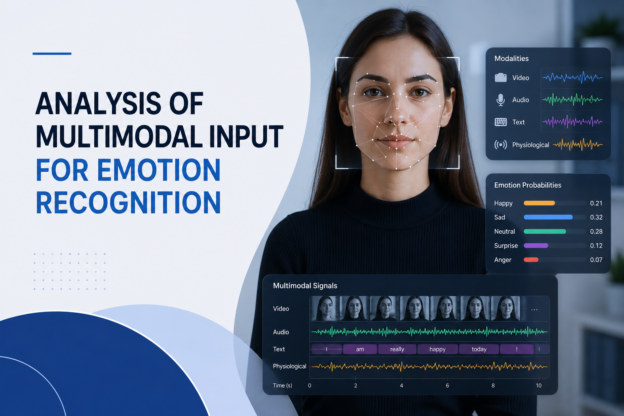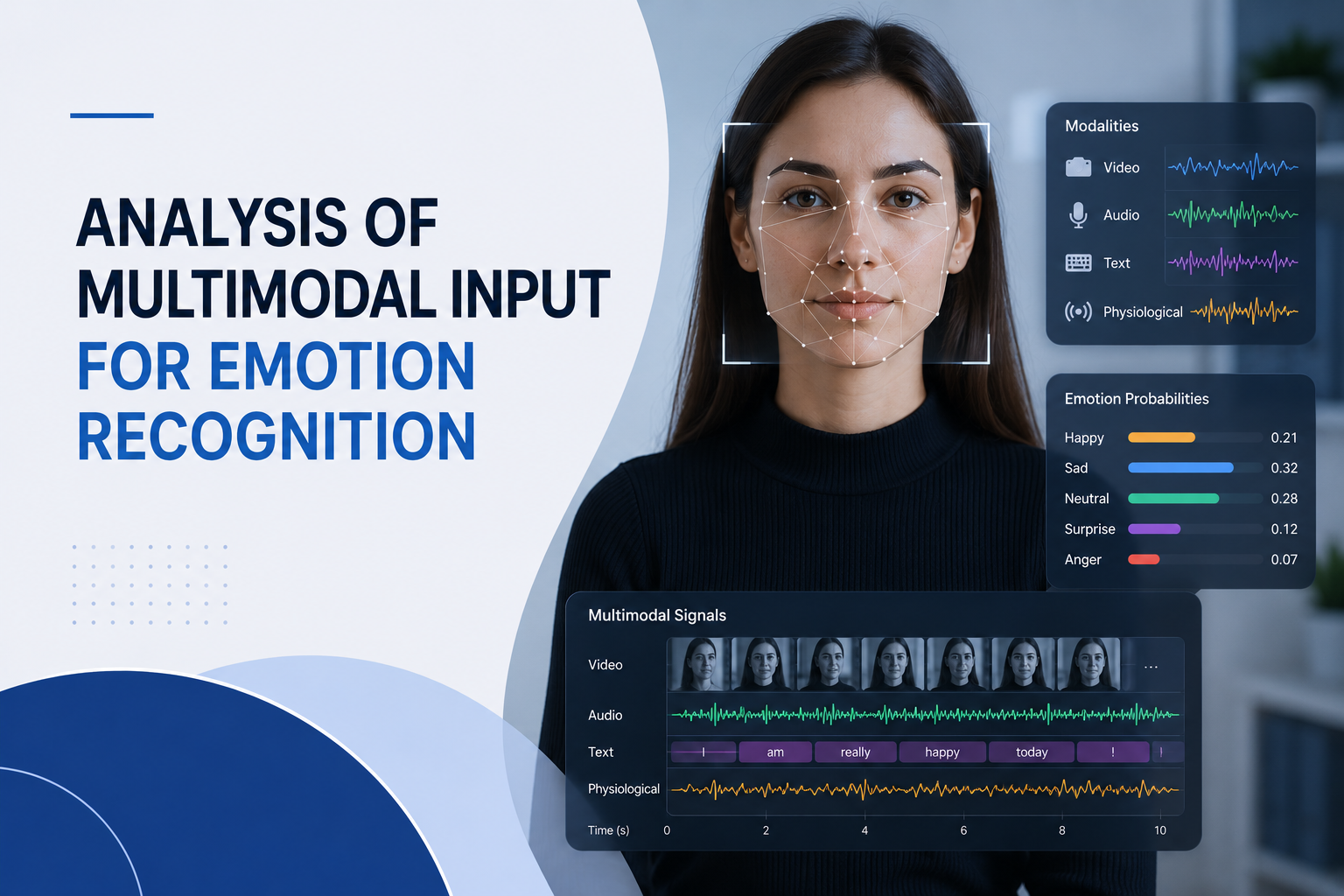
Lesson 1- Introduction to Multimodal Emotion Recognition
Learning Objectives
After completing this lesson, you will be able to:
- Define emotion recognition and explain its importance in Artificial Intelligence.
- Understand the difference between unimodal and multimodal emotion recognition.
- Identify the main sources of emotional information used in AI systems.
- Explain why combining multiple modalities improves emotion recognition accuracy.
- Recognize real-world applications of multimodal emotion recognition.
Introduction
Humans naturally recognize emotions during everyday interactions. We observe facial expressions, listen to tone of voice, interpret body language, and consider the surrounding context before deciding whether someone is happy, frustrated, surprised, or anxious.
This ability is so automatic that we rarely think about the amount of information our brains process simultaneously. A simple conversation involves multiple communication channels operating together: facial movements, eye contact, speech, gestures, posture, and even silence all contribute to our understanding of another person’s emotional state.
Artificial Intelligence aims to replicate this capability by developing systems that can automatically detect and interpret human emotions. This field is known as Emotion Recognition or Affective Computing.
Early emotion recognition systems relied on a single source of information, such as facial expressions or speech. While these approaches achieved promising results, they often struggled in real-world situations where emotions are complex and influenced by multiple factors.
Today, researchers increasingly rely on multimodal emotion recognition, an approach that combines several types of information to produce a more accurate and reliable understanding of human emotions.
ANALYSIS OF MULTIMODAL.pdf
What is Emotion Recognition?
Emotion recognition is the process of identifying and classifying human emotional states using observable behavioral or physiological signals.
An emotion recognition system receives information from one or more sensors, analyzes relevant features, and predicts the emotional state of the individual.
Depending on the application, the system may classify emotions into categories such as:
- Happiness
- Sadness
- Anger
- Fear
- Surprise
- Disgust
- Neutral
Other systems represent emotions using continuous dimensions, such as:
- Valence (positive versus negative emotion)
- Arousal (level of activation or excitement)
- Dominance (feeling of control or submission)
Both approaches are widely used depending on the objectives of the application.
Emotion recognition plays an increasingly important role in human-computer interaction because it enables systems to respond more naturally to users’ emotional states.
From Unimodal to Multimodal Analysis
The earliest emotion recognition systems focused on a single communication channel.
For example:
- A camera could analyze facial expressions.
- A microphone could analyze speech.
- A wearable device could monitor heart rate.
These are known as unimodal systems because they rely on only one modality.
Although unimodal systems are often simpler to develop, they have important limitations.
Imagine trying to determine whether someone is nervous based only on facial expressions.
The individual may deliberately hide their emotions.
Alternatively, imagine relying only on speech.
Background noise, language differences, or recording quality may reduce accuracy.
Humans naturally overcome these challenges by combining multiple sources of information.
Multimodal emotion recognition follows the same principle.
Instead of depending on a single signal, it analyzes several complementary sources simultaneously, allowing AI systems to make more robust and reliable predictions.
What Does “Multimodal” Mean?
The term multimodal refers to the integration of different types of data describing the same event or interaction.
In emotion recognition, common modalities include:
Facial Expressions
Cameras capture facial movements such as smiling, frowning, eyebrow movement, or eye activity.
Facial expressions often provide immediate visual evidence of emotional reactions.
Speech and Voice
Speech analysis considers both what people say and how they say it.
Important vocal characteristics include:
- Pitch
- Intonation
- Speaking rate
- Volume
- Pauses
- Voice quality
Changes in these characteristics frequently reflect emotional states.
Body Language
Body posture, gestures, and movement patterns provide additional information that may not be visible through facial expressions alone.
For example, crossed arms, slumped shoulders, or rapid hand movements may indicate emotional tension or confidence.
Physiological Signals
Wearable sensors can measure physiological responses such as:
- Heart rate
- Skin temperature
- Electrodermal activity (EDA)
- Respiration
- Brain activity (EEG)
These signals often reveal emotional reactions that individuals cannot consciously control.
Contextual Information
Context also influences emotional interpretation.
The same facial expression may represent excitement during a sporting event but anxiety during a medical examination.
Modern AI systems increasingly incorporate contextual information to improve interpretation accuracy.
ANALYSIS OF MULTIMODAL.pdf
Why Multiple Modalities Improve Accuracy
Human emotions are complex.
No single signal perfectly represents how someone feels.
Consider a customer speaking with a virtual assistant.
The customer’s facial expression appears neutral.
However, their voice becomes louder and faster.
Their heart rate increases, and they repeatedly interrupt the conversation.
Each individual signal provides only partial information.
When combined, these observations strongly suggest growing frustration.
This illustrates one of the greatest advantages of multimodal analysis.
Different modalities compensate for each other’s weaknesses.
If one source becomes unreliable—for example, poor lighting affecting facial recognition—other modalities can continue providing useful information.
The result is a system that performs more reliably under real-world conditions.
Applications of Multimodal Emotion Recognition
Emotion recognition technologies are increasingly being integrated into many industries.
Healthcare
Clinicians may use emotion recognition to monitor patients with depression, anxiety, or neurological disorders.
Continuous emotional monitoring can support diagnosis and treatment decisions.
Education
Intelligent tutoring systems can detect when students become confused, frustrated, or disengaged.
The learning platform may then provide additional explanations, hints, or alternative learning materials.
Customer Service
Companies use emotion recognition to evaluate customer satisfaction during support calls.
Virtual assistants may adapt their responses when detecting signs of frustration or stress.
Automotive Systems
Modern vehicles increasingly include driver monitoring systems capable of detecting fatigue, distraction, or emotional stress.
These systems improve road safety by alerting drivers before dangerous situations occur.
Human-Robot Interaction
Social robots designed for healthcare, education, or customer support rely on emotion recognition to produce more natural and empathetic interactions.
Recognizing users’ emotional states allows robots to adjust their communication style appropriately.
Challenges in Emotion Recognition
Although significant progress has been made, recognizing emotions remains a complex task.
Several challenges continue to affect system performance.
Individual Differences
People express emotions differently depending on personality, culture, age, and personal experience.
Environmental Conditions
Lighting, camera quality, microphone noise, and sensor accuracy all influence data quality.
Ambiguous Emotions
Humans often experience multiple emotions simultaneously.
Someone may feel excited and nervous at the same time.
Recognizing these mixed emotional states remains difficult for AI systems.
Privacy and Ethics
Emotion recognition involves highly sensitive personal information.
Organizations must ensure that emotional data is collected responsibly, stored securely, and processed in accordance with ethical and legal standards.
Developers should always prioritize transparency, user consent, and privacy protection when designing emotion-aware systems.
ANALYSIS OF MULTIMODAL.pdf
Practical Example
Imagine an online learning platform designed to support university students.
During a lesson, the system analyzes multiple sources of information.
A webcam detects repeated signs of confusion through facial expressions.
Speech analysis identifies hesitation when students answer questions aloud.
At the same time, interaction logs show frequent pauses and repeated attempts to solve the same exercise.
Rather than relying on a single observation, the platform combines all these signals to conclude that the learner may be struggling with the material.
It then responds by offering additional explanations, simplified examples, or optional review exercises.
This illustrates how multimodal emotion recognition enables intelligent systems to provide more personalized and supportive learning experiences.
Key Takeaways
- Emotion recognition enables AI systems to identify human emotional states using observable signals.
- Multimodal emotion recognition combines several communication channels to improve accuracy.
- Common modalities include facial expressions, speech, body language, physiological signals, and contextual information.
- Combining multiple modalities creates more robust and reliable emotion recognition systems than relying on a single source of data.
- Emotion recognition has important applications in healthcare, education, customer service, transportation, and human-computer interaction.
- Ethical considerations, privacy protection, and responsible AI development are essential when working with emotional data.
Before You Continue
The next time you interact with another person, pay attention to the different sources of information you use to understand their emotions.
Ask yourself:
- Am I relying only on facial expressions?
- How does tone of voice influence my interpretation?
- What role do gestures and context play?