
Advanced Innovation & entrepreneurship
-
Introduction
-
MODULE 1: CAPITAL, VALUE, AND ORGANIZATION
Unit 1 Value Creation, the production results2 Topics|1 Quiz -
Unit 2 What is the capital and how is it build ?2 Topics|1 Quiz
-
Unit 3 : Division and organisation of Labor3 Topics|1 Quiz
-
Unit 4 : Capturing and Retaining Created Value2 Topics|1 Quiz
-
Unit 5 : Value chains and their fragmentation, maximizing the value captured2 Topics|1 Quiz
-
MODULE 2: INNOVATION AS A SOCIAL PROCESSUnit 6 : Adoption, a frontier between invention and innovation2 Topics|1 Quiz
-
Unit 7 : Innovation as a social process2 Topics|1 Quiz
-
Unit 8 : Location and Links in innovation3 Topics|1 Quiz
-
Unit 9 : Innovation process between companies2 Topics|1 Quiz
-
Unit 10 : The case of Knowledge industries3 Topics|1 Quiz
-
Unit 11: Values typologie2 Topics|1 Quiz
-
Unit 12 : Innovation as a process of value proposal3 Topics|1 Quiz
-
MODULE 3: DIGITAL TRANSFORMATION, INTANGIBLE CAPITAL AND RESPONSIBILITYUnit 13 : Digital transformation2 Topics|1 Quiz
-
Unit 14 : Intangible capital role in Innovation4 Topics|1 Quiz
-
Unit 15 : Public investment generating positive externalities in service of innovation3 Topics|1 Quiz
-
Unit 16 : Corporate social and environmental responsibility in an innovation context2 Topics|1 Quiz
-
Unit 17 : Innovative management methods of companies2 Topics|1 Quiz
-
Conclusion and ReferencesGeneral Conclusion
-
Bibliographic references
-
Final Assessment1 Quiz

Use the Listen button to hear the transcript. You can pause and resume the audio, and stop it at any time.
Note: You need to mute the video to hear the transcript in other languages instead of English or it will overlap with the video audio.
Please also keep in mind not all languages are supported by the TTS engine.
1.1 The Production Function: Neoclassical Framework
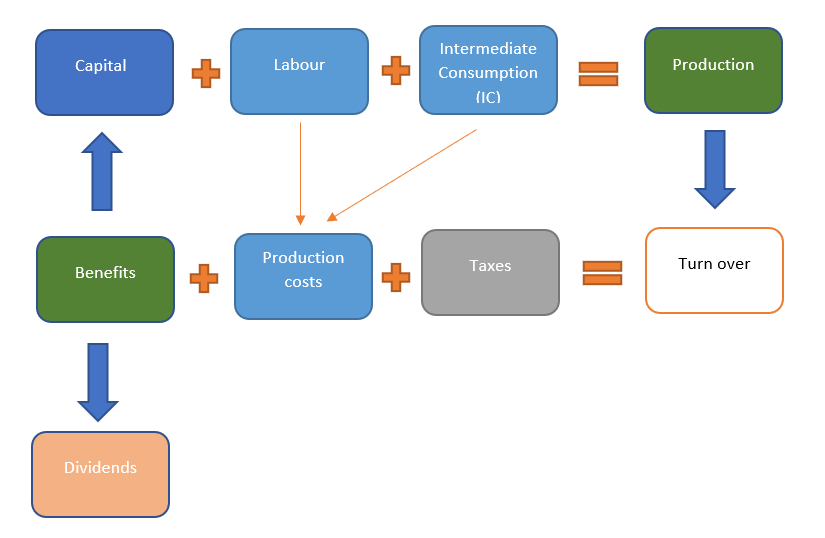
Economic theory conceives of production as an organized combination of factors—labor, capital, natural resources—transformed into goods and services. This conception finds its formalization in the concept of the production function, which establishes a technical relationship between the quantities of inputs used and the volume of output obtained.
In the neoclassical tradition, the production function generally takes the form Y = f(K, L), where Y denotes output, K the capital stock, and L the labor factor (Samuelson, 1947). Adam Smith’s (1776) foundational work had already highlighted the role of the division of labor in productivity growth, through the famous example of the pin factory.
1.2 Factor Substitutability and Optimal Combination
A major contribution of neoclassical analysis lies in the theorization of factor substitutability. In many production processes, capital can substitute for labor at a diminishing marginal rate of technical substitution. The rational entrepreneur seeks the combination that minimizes total cost for a given output level, or maximizes output for a given budget (Varian, 1992).
The introduction of sewing machines in the textile industry during the nineteenth century historically illustrates this substitutability: a machine could perform the work of several workers, profoundly modifying the optimal proportions between capital and labor (Mokyr, 1990).
1.3 Value Added and Productive Surplus
The production process generates value added, defined as the difference between the value of output and that of intermediate consumption. This value added constitutes the source of income distributed to various stakeholders: profits for capital owners, wages for workers, tax revenues for the state.
The fundamental hypothesis of the capitalist economy is that the value created exceeds the value of resources consumed in the production process. This surplus, the source of accumulation, has been analyzed differently across theoretical traditions—as marginal factor productivity among neoclassicists, as surplus value extracted from labor in Marx (1867).