
Advanced Innovation & entrepreneurship
-
Introduction
-
MODULE 1: CAPITAL, VALUE, AND ORGANIZATION
Unit 1 Value Creation, the production results2 Topics|1 Quiz -
Unit 2 What is the capital and how is it build ?2 Topics|1 Quiz
-
Unit 3 : Division and organisation of Labor3 Topics|1 Quiz
-
Unit 4 : Capturing and Retaining Created Value2 Topics|1 Quiz
-
Unit 5 : Value chains and their fragmentation, maximizing the value captured2 Topics|1 Quiz
-
MODULE 2: INNOVATION AS A SOCIAL PROCESSUnit 6 : Adoption, a frontier between invention and innovation2 Topics|1 Quiz
-
Unit 7 : Innovation as a social process2 Topics|1 Quiz
-
Unit 8 : Location and Links in innovation3 Topics|1 Quiz
-
Unit 9 : Innovation process between companies2 Topics|1 Quiz
-
Unit 10 : The case of Knowledge industries3 Topics|1 Quiz
-
Unit 11: Values typologie2 Topics|1 Quiz
-
Unit 12 : Innovation as a process of value proposal3 Topics|1 Quiz
-
MODULE 3: DIGITAL TRANSFORMATION, INTANGIBLE CAPITAL AND RESPONSIBILITYUnit 13 : Digital transformation2 Topics|1 Quiz
-
Unit 14 : Intangible capital role in Innovation4 Topics|1 Quiz
-
Unit 15 : Public investment generating positive externalities in service of innovation3 Topics|1 Quiz
-
Unit 16 : Corporate social and environmental responsibility in an innovation context2 Topics|1 Quiz
-
Unit 17 : Innovative management methods of companies2 Topics|1 Quiz
-
Conclusion and ReferencesGeneral Conclusion
-
Bibliographic references
-
Final Assessment1 Quiz

Use the Listen button to hear the transcript. You can pause and resume the audio, and stop it at any time.
Note: You need to mute the video to hear the transcript in other languages instead of English or it will overlap with the video audio.
Please also keep in mind not all languages are supported by the TTS engine.
From Vertical Integration to Global Fragmentation
In 1913, Ford vertically integrated almost its entire production chain: steel mills, glassworks, rubber plantations for tires. The company controlled each stage, from raw materials to finished product.
A contemporary iPhone mobilizes components and operations distributed across more than forty countries, assembled by Foxconn—a Taiwanese subcontractor largely unknown to the general public. This evolution illustrates a structural transformation: the fragmentation of global value chains.
The Value Chain Concept: Porter’s Contribution
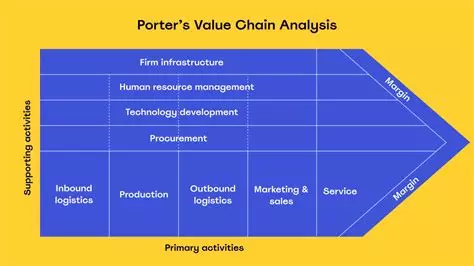
Porter (1985) formalized the value chain concept to analyze sources of competitive advantage. The value chain decomposes the firm into strategically relevant activities:
Primary activities: inbound logistics, operations, outbound logistics, marketing and sales, service.
Support activities: firm infrastructure, human resource management, technology development, procurement.
Value chain analysis enables identification of the links where the firm creates—or can create—a differential advantage.
Logics of Vertical Integration
Historically, large industrial firms tended to integrate vertically. Transaction cost theory (Williamson, 1975) explains this tendency: when market transactions are costly—due to uncertainty, asset specificity, or transaction frequency—integration within a hierarchy may prove more efficient.
In the 1950s, General Motors controlled approximately 70% of its value chain. Integration guaranteed quality control, supply security, and operational coordination.
Factors of Fragmentation
Beginning in the 1980s, several factors favored vertical disintegration and international fragmentation of value chains.
Reduction in coordination costs: Advances in transport (containerization) and communications (then the Internet) drastically reduced the costs of distance coordination. Coordinating geographically dispersed operations became economically viable.
Core competencies doctrine: Managerial thinking evolved. Prahalad and Hamel (1990) popularized the concept of “core competencies”: the firm should focus on what it does better than anyone and outsource the rest.
Cost arbitrage: Fragmentation enables exploitation of international labor cost differentials. Labor-intensive tasks are relocated to low-wage countries ($5 per hour in Asia versus $35 in Western Europe).
Product modularity: Modular design, with standardized interfaces between components, facilitates fragmentation. A computer decomposes into modules—processor (Intel), graphics card (Nvidia), memory (Samsung)—assembled by an integrator (Dell).
Contemporary Configuration of Global Value Chains
Today, approximately 70% of international trade concerns intermediate goods, not finished products (WTO, 2019). Components are exchanged between subsidiaries and subcontractors, not final merchandise.
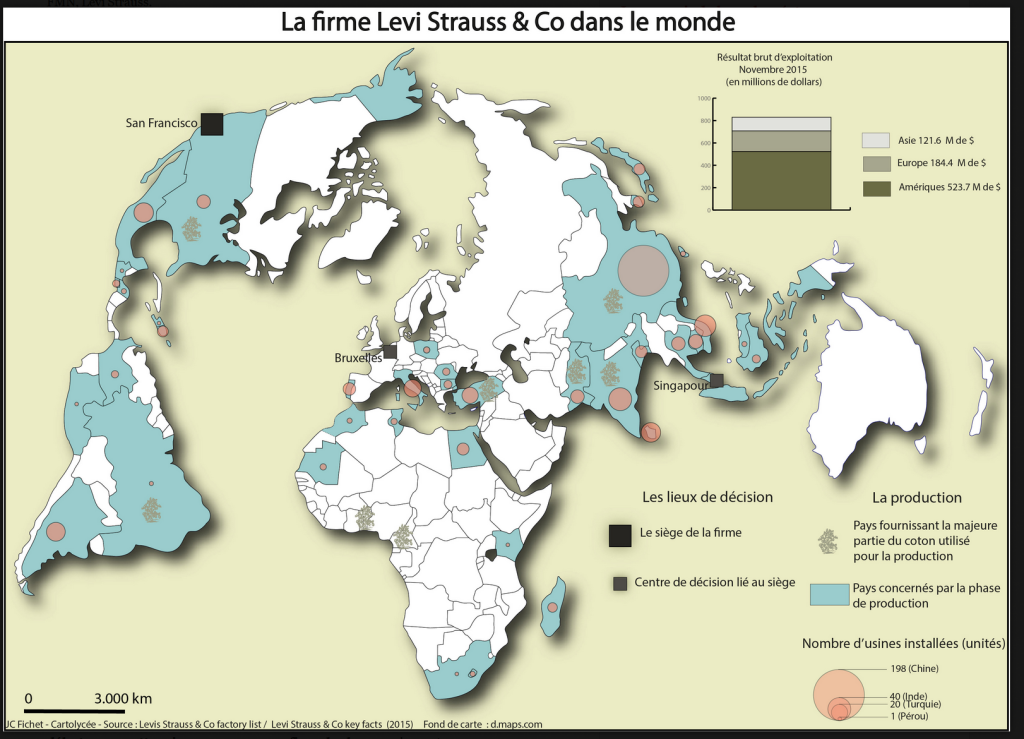
A pair of jeans illustrates the typical geographic dispersion: cotton grown in the United States, spun in Turkey, woven in India, dyed in China, assembled in Bangladesh, sold in Europe. A single product travels 50,000 kilometers before reaching the consumer.
Gereffi and Fernandez-Stark (2016) distinguish several value chain governance configurations:
- Producer-driven chains: In automobiles or electronics, large manufacturers coordinate their supplier networks.
- Buyer-driven chains: In textiles or toys, brands and retailers coordinate dispersed manufacturers.
- Relational chains: Based on trust and geographic or cultural proximity.
Risks and Vulnerabilities of Fragmentation
Value chain fragmentation generates systemic vulnerabilities that the Covid-19 pandemic brutally revealed.
An IMF study (2020) showed that 80% of firms experienced supply disruptions during the health crisis. The Suez Canal blockage in March 2021—only six days—affected 12% of world trade.
Long chains amplify shocks. A phenomenon called the “bullwhip effect” transforms a moderate variation in final demand into large fluctuations among upstream suppliers. A 10% drop in demand can translate into a 40% drop in orders at third- or fourth-tier suppliers.
Geographic concentration creates bottlenecks. TSMC (Taiwan Semiconductor Manufacturing Company) manufactures 92% of chips below 10 nanometers. Apple, Nvidia, and Sony depend on this single supplier. A disruption in Taiwan would threaten the entire global electronics industry.
Perspectives: Regionalization and Resilience
Fragmentation has reduced production costs, but it has created new costs: coordination, risk management, complexity. A BCG survey (2022) indicates that 65% of firms are considering regionalizing their supply chains.
Relocalization or “nearshoring” movements are emerging. Adidas has reopened factories in Germany with robots. Apple is diversifying its assembly sites to India and Vietnam to reduce its dependence on China.
The strategic question remains open: how can efficiency (cost minimization) and resilience (capacity to absorb shocks) be articulated in complex value chains?