Advanced Innovation & entrepreneurship
-
Introduction
-
MODULE 1: CAPITAL, VALUE, AND ORGANIZATION
Unit 1 Value Creation, the production results2 Topics|1 Quiz -
Unit 2 What is the capital and how is it build ?2 Topics|1 Quiz
-
Unit 3 : Division and organisation of Labor3 Topics|1 Quiz
-
Unit 4 : Capturing and Retaining Created Value2 Topics|1 Quiz
-
Unit 5 : Value chains and their fragmentation, maximizing the value captured2 Topics|1 Quiz
-
MODULE 2: INNOVATION AS A SOCIAL PROCESSUnit 6 : Adoption, a frontier between invention and innovation2 Topics|1 Quiz
-
Unit 7 : Innovation as a social process2 Topics|1 Quiz
-
Unit 8 : Location and Links in innovation3 Topics|1 Quiz
-
Unit 9 : Innovation process between companies2 Topics|1 Quiz
-
Unit 10 : The case of Knowledge industries3 Topics|1 Quiz
-
Unit 11: Values typologie2 Topics|1 Quiz
-
Unit 12 : Innovation as a process of value proposal3 Topics|1 Quiz
-
MODULE 3: DIGITAL TRANSFORMATION, INTANGIBLE CAPITAL AND RESPONSIBILITYUnit 13 : Digital transformation2 Topics|1 Quiz
-
Unit 14 : Intangible capital role in Innovation4 Topics|1 Quiz
-
Unit 15 : Public investment generating positive externalities in service of innovation3 Topics|1 Quiz
-
Unit 16 : Corporate social and environmental responsibility in an innovation context2 Topics|1 Quiz
-
Unit 17 : Innovative management methods of companies2 Topics|1 Quiz
-
Conclusion and ReferencesGeneral Conclusion
-
Bibliographic references
-
Final Assessment1 Quiz
The Question of Intellectual Property

Alvaro Pina Stranger 04/11/2026
Use the Listen button to hear the transcript. You can pause and resume the audio, and stop it at any time.
Note: You need to mute the video to hear the transcript in other languages instead of English or it will overlap with the video audio.
Please also keep in mind not all languages are supported by the TTS engine.
Nature and Functions of Intellectual Property
We continue our study of intangible capital with intellectual property.
Intellectual property comes in many forms. And among them, the patent is a key tool for innovation. Intellectual property also “finances” innovation: it creates a temporary monopoly on a new idea. This protected period helps companies recover their investment.
Situations similar to patents existed in antiquity and in Venice in the fifteenth century. But the modern idea of intellectual property appears much later, with the creation of the World Intellectual Property Organization in 1967.
Historically, the rise of legal protection for inventions goes hand in hand with the growth of large markets. As markets expanded, companies needed tools to protect and monetize new ideas.
Definitions and Types
IP refers to creations of the mind: inventions, literary and artistic works, designs, symbols, names, and images used in commerce.
Legally, intellectual property grants exclusive rights for a limited duration. These rights allow creators to control and monetize their work.
In management sciences, IP is seen as a strategic resource. Companies use it to protect their innovations and build competitive advantages. IP works as an appropriation mechanism. It prevents imitation and secures returns on R&D.
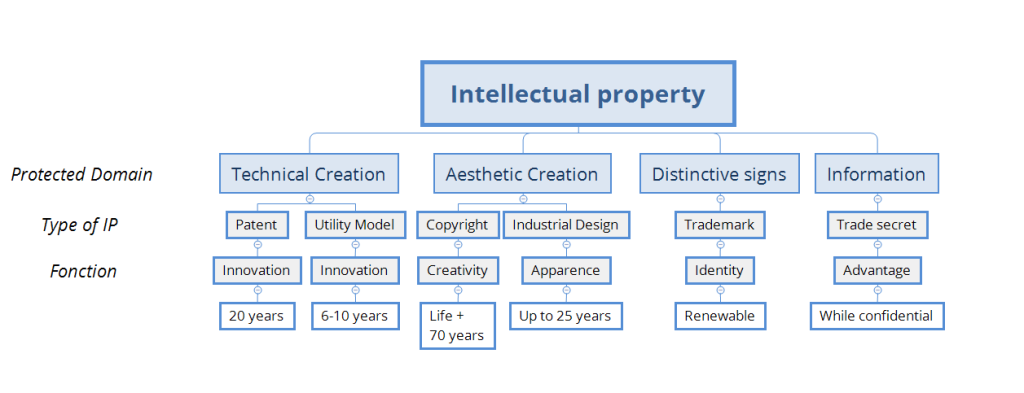
Different types of IP protect different things. Patents protect technical innovations. Copyrights protect artistic and literary works. Design patents protect appearance
Sectoral Examples
Think of the pharmaceutical sector. Companies like Pfizer invest billions in drug development. Patent protection is essential to recover these costs. Lipitor alone generated over 125 billion dollars during its patent life.
Trade secrets also matter. Google’s PageRank algorithm is not patented. It is kept secret. And this secret gives a long-term competitive advantage.
Copyrights support digital platforms. Netflix relies on copyright to protect its original content, which helps the company stand out from competitors.
Design patents matter in electronics. Apple uses them to defend key elements of the iPhone against competitors.
IP Between Supporting and Hindering Innovation
All forms of IP have a limited duration. This is why some use trade secrets, which can last indefinitely if kept confidential.
Why limited? Because IP creates a monopoly. And monopolies are seen as inefficient by economic theory. Our system aims to reduce them. But in some cases, temporary monopolies are needed to support innovation.
IP helps innovators capture value. Without protection, knowledge spreads. Competitors copy. And companies would invest less in R&D.
But the relationship between IP and innovation is not simple. Strong protection can help innovation. But excessive protection can slow it down, block access to knowledge, and limit cumulative innovation. This is particularly true in software and biotechnology, where each discovery builds on the previous one. Too many barriers make progress harder.
IP can also be diverted. In the American semiconductor industry, it has been shown that companies often file patents with little real innovation. The goal is to build large portfolios, not to invent but to strengthen monopoly power.
Yet IP also improves knowledge sharing. Patent disclosure makes technology more transparent. Companies can identify partners, licensing opportunities, and research directions. Tacit knowledge becomes codified knowledge. And this can accelerate progress.