
Advanced Innovation & entrepreneurship
-
Introduction
-
MODULE 1: CAPITAL, VALUE, AND ORGANIZATION
Unit 1 Value Creation, the production results2 Topics|1 Quiz -
Unit 2 What is the capital and how is it build ?2 Topics|1 Quiz
-
Unit 3 : Division and organisation of Labor3 Topics|1 Quiz
-
Unit 4 : Capturing and Retaining Created Value2 Topics|1 Quiz
-
Unit 5 : Value chains and their fragmentation, maximizing the value captured2 Topics|1 Quiz
-
MODULE 2: INNOVATION AS A SOCIAL PROCESSUnit 6 : Adoption, a frontier between invention and innovation2 Topics|1 Quiz
-
Unit 7 : Innovation as a social process2 Topics|1 Quiz
-
Unit 8 : Location and Links in innovation3 Topics|1 Quiz
-
Unit 9 : Innovation process between companies2 Topics|1 Quiz
-
Unit 10 : The case of Knowledge industries3 Topics|1 Quiz
-
Unit 11: Values typologie2 Topics|1 Quiz
-
Unit 12 : Innovation as a process of value proposal3 Topics|1 Quiz
-
MODULE 3: DIGITAL TRANSFORMATION, INTANGIBLE CAPITAL AND RESPONSIBILITYUnit 13 : Digital transformation2 Topics|1 Quiz
-
Unit 14 : Intangible capital role in Innovation4 Topics|1 Quiz
-
Unit 15 : Public investment generating positive externalities in service of innovation3 Topics|1 Quiz
-
Unit 16 : Corporate social and environmental responsibility in an innovation context2 Topics|1 Quiz
-
Unit 17 : Innovative management methods of companies2 Topics|1 Quiz
-
Conclusion and ReferencesGeneral Conclusion
-
Bibliographic references
-
Final Assessment1 Quiz
The distinction between tangible and intangible capital: the challenge of measuring innovation

Alvaro Pina Stranger 04/11/2026
Use the Listen button to hear the transcript. You can pause and resume the audio, and stop it at any time.
Note: You need to mute the video to hear the transcript in other languages instead of English or it will overlap with the video audio.
Please also keep in mind not all languages are supported by the TTS engine.
Beyond the Goods/Services Dichotomy
The elementary distinction between goods (material) and services (immaterial) proves insufficient to grasp contemporary economic transformations. A more pertinent criterion is that of temporality: a service is consumed at the moment of its production (simultaneity characteristic), while a good can be stored for deferred use.
Within this framework, an intangible asset is defined as a storable immaterial good: codified information, patent, intellectual property right, software, brand, organizational know-how. The link with innovation is immediate: the contemporary economy increasingly relies on these immaterial assets (Corrado, Hulten & Sichel, 2009).
The Shift Toward the Intangible Economy: Empirical Evidence
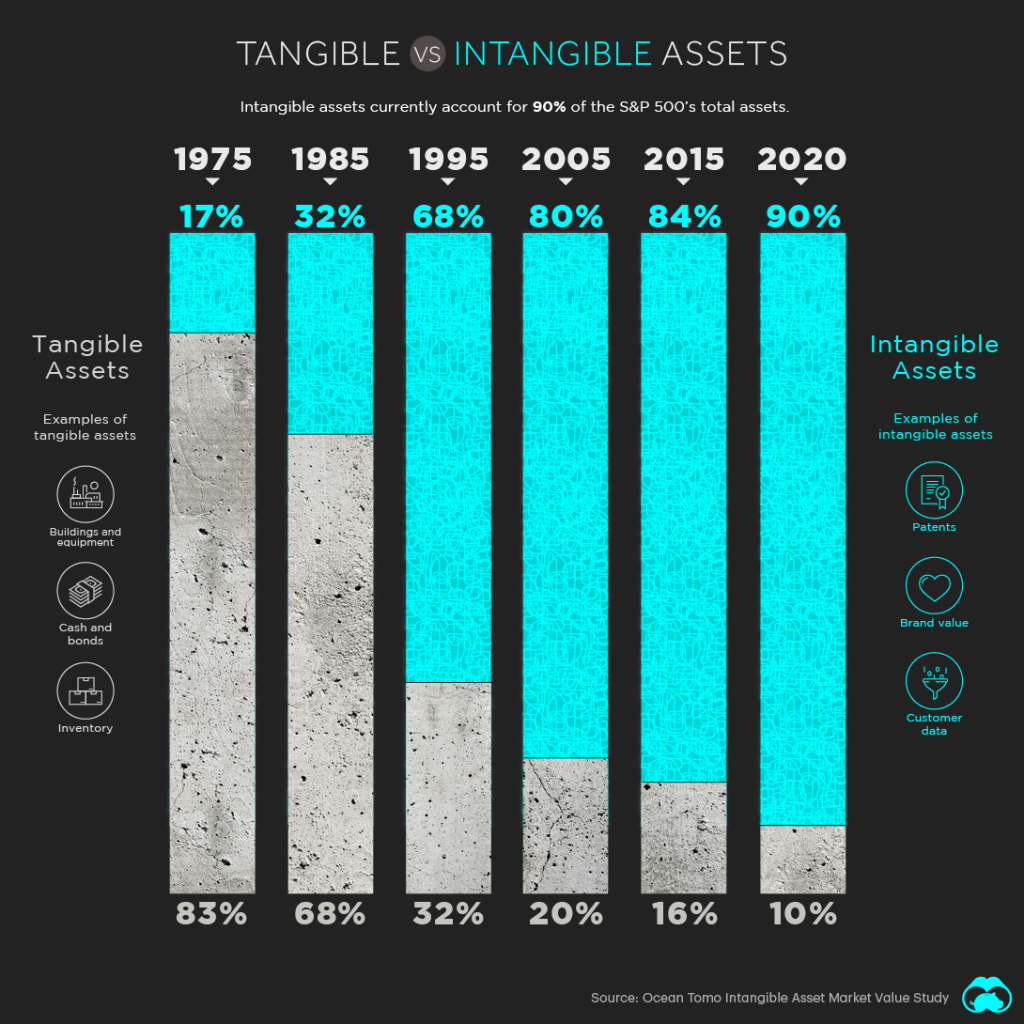
Empirical data attest to a structural transformation. In 1975, tangible assets—equipment, buildings, inventories—represented 83% of the market capitalization of S&P 500 companies. By 2020, this ratio had reversed: 90% of market value now corresponds to intangible assets—patents, brands, software, data, organizational capital (Ocean Tomo, 2020).
This mutation reflects a shift from the industrial economy to the knowledge economy. Microsoft exceeds in valuation the entire American automobile industry without owning assembly lines. Airbnb exceeds Marriott in market capitalization without owning a single hotel. Value migrates from physical assets to cognitive assets.
Lorem ipsum dolor sit amet, consectetur adipiscing elit. Ut elit tellus, luctus nec ullamcorper mattis, pulvinar dapibus leo.
Specific Economic Properties of Intangible Capital
Haskel and Westlake (2018), in Capitalism without Capital, identify four distinctive properties of intangible capital, summarized by the acronym of the “4 S’s”: scalability, sunkenness, spillovers, synergies.
Scalability (economies of scale): Intangible assets have near-zero reproduction costs. Developing software represents a considerable investment; duplicating it costs almost nothing. This cost structure—high fixed costs, negligible marginal costs—generates increasing returns to scale and favors monopolistic dynamics.
Sunkenness (irrecoverability): Intangible investments are largely irrecoverable in case of failure. A machine can be resold on a second-hand market; an aborted R&D campaign or a devalued brand cannot. This characteristic increases the risk of intangible investments.
Spillovers (externalities): Intangible assets generate returns that are difficult to control. An innovation can be imitated, know-how can spread through employee mobility. These positive externalities benefit third parties who have not borne the cost of the initial investment.
Synergies: Intangible assets combine and cross-fertilize. Innovation often results from the recombination of preexisting elements (Schumpeter, 1934). This complementarity creates network effects and favors geographic concentration in innovative clusters.
Inadequacy of Accounting Systems
Current accounting conventions, developed for an industrial economy, struggle to capture intangible capital. R&D is generally recorded as an operating expense, not as a fixed asset, even though it constitutes an investment generating future value. Employee training expenditure reduces accounting profit, although it increases the firm’s human capital.
This inadequacy generates paradoxes. When Amazon massively increases its R&D investments, its accounting profit decreases—but its stock price rises. Financial markets perceive the future value that accounting does not reflect.
Traditional financial institutions remain attached to a tangible asset vision. Banks accept industrial equipment as loan collateral; they refuse an algorithm or a database. This asymmetry constrains innovative firms to resort to venture capital, which is scarcer and more expensive than bank credit.
Challenges of Innovation Measurement
Traditional innovation indicators—patents filed, R&D expenditure—capture only a limited dimension of the phenomenon. Apple ranks among the world’s most innovative companies with R&D budgets that are lower, as a proportion of revenue, than those of many less creative competitors.
The very nature of innovation makes it resistant to measurement. To innovate is to create novelty—something that, by definition, did not previously exist and therefore escapes pre-established metrics. How can we compare Uber’s innovation (new business model), Tesla’s innovation (new technology), and Instagram’s innovation (new usage)? These innovations transform heterogeneous dimensions of the economy and society.
The performativity of indicators constitutes an additional risk. As Goodhart (1975) theorized, when a measure becomes a target, it ceases to be a good measure. The European Union had set a target of 3% of GDP devoted to R&D; the target was not achieved, but innovative ecosystems nevertheless emerged. The metric missed the essence of the phenomenon it claimed to measure.