
Advanced Innovation & entrepreneurship
-
Introduction
-
MODULE 1: CAPITAL, VALUE, AND ORGANIZATION
Unit 1 Value Creation, the production results2 Topics|1 Quiz -
Unit 2 What is the capital and how is it build ?2 Topics|1 Quiz
-
Unit 3 : Division and organisation of Labor3 Topics|1 Quiz
-
Unit 4 : Capturing and Retaining Created Value2 Topics|1 Quiz
-
Unit 5 : Value chains and their fragmentation, maximizing the value captured2 Topics|1 Quiz
-
MODULE 2: INNOVATION AS A SOCIAL PROCESSUnit 6 : Adoption, a frontier between invention and innovation2 Topics|1 Quiz
-
Unit 7 : Innovation as a social process2 Topics|1 Quiz
-
Unit 8 : Location and Links in innovation3 Topics|1 Quiz
-
Unit 9 : Innovation process between companies2 Topics|1 Quiz
-
Unit 10 : The case of Knowledge industries3 Topics|1 Quiz
-
Unit 11: Values typologie2 Topics|1 Quiz
-
Unit 12 : Innovation as a process of value proposal3 Topics|1 Quiz
-
MODULE 3: DIGITAL TRANSFORMATION, INTANGIBLE CAPITAL AND RESPONSIBILITYUnit 13 : Digital transformation2 Topics|1 Quiz
-
Unit 14 : Intangible capital role in Innovation4 Topics|1 Quiz
-
Unit 15 : Public investment generating positive externalities in service of innovation3 Topics|1 Quiz
-
Unit 16 : Corporate social and environmental responsibility in an innovation context2 Topics|1 Quiz
-
Unit 17 : Innovative management methods of companies2 Topics|1 Quiz
-
Conclusion and ReferencesGeneral Conclusion
-
Bibliographic references
-
Final Assessment1 Quiz

Use the Listen button to hear the transcript. You can pause and resume the audio, and stop it at any time.
Note: You need to mute the video to hear the transcript in other languages instead of English or it will overlap with the video audio.
Please also keep in mind not all languages are supported by the TTS engine.
The Labor/Capital Dichotomy: Theoretical Stakes
The distinction between labor and capital constitutes one of the fundamental categories of economic analysis. Labor designates human effort, physical or intellectual, directly engaged in the production process. Capital designates all durable assets that contribute to production without being immediately consumed: equipment, buildings, patents, financial assets.
This apparently simple distinction has fueled three centuries of theoretical controversy concerning both the nature of capital and the legitimacy of the income it generates.
The Classical Conception: Smith and the Dynamics of Accumulation
In The Wealth of Nations, Adam Smith (1776) defines capital as that part of a person’s stock from which they expect to derive revenue. This functional definition emphasizes that it is not the physical nature of a good that makes it capital, but its insertion into an accumulation process. A plow is capital only if it serves to produce wheat destined for sale.
Smith perceives in capital accumulation the engine of economic progress. Capital enables the division of labor: the entrepreneur with funds can acquire equipment, build workshops, employ specialists, and thereby increase productivity. Reinvested profits generate more capital, which allows for a more elaborate division of labor, in a cumulative dynamic.
However, Smith also identifies the distributional tensions inherent in the system. The interests of capital owners and workers are structurally divergent: the former seek to maximize profits, which implies compressing wages; the latter aspire to increase their remuneration. The market arbitrates this conflict, but equilibrium remains precarious.
The Marxian Critique: Capital as a Social Relation
Karl Marx (1867), in Capital, radicalizes Smith’s analysis. For Marx, capital is not a thing but a social relation of production. Equipment becomes capital only within an exploitative relationship where its owner employs wage workers.
Marx develops the concept of surplus value (Mehrwert). If a worker labors for ten hours, only a fraction of this time—say, six hours—produces the equivalent of their wage (necessary labor). The remaining hours constitute surplus labor, whose product is appropriated by the capitalist. When reinvested, the surplus value thus extracted generates additional capital. Capital is therefore not accumulated labor (accumulated labor), but accumulated unpaid labor (accumulated unpaid labor).
This mechanism induces, according to Marx, an increasing social polarization. Capital accumulation enables the extraction of more surplus value, which enables the accumulation of more capital. Wealth concentrates at one pole of society while the laboring class expands at the other.
History has only partially validated these predictions. Capitalism has demonstrated an adaptability that Marx underestimated: the emergence of middle classes, the extension of the welfare state, the diffusion of property through pension savings or homeownership. Nevertheless, the logic of accumulation and the inequalities it generates remain structural features of capitalist economies.
Piketty and the Return of the Capital Question
French economist Thomas Piketty (2013) renewed the debate with Capital in the Twenty-First Century. His central thesis is expressed by a fundamental inequality: r > g, where r denotes the rate of return on capital and g the rate of economic growth.
When r durably exceeds g, wealth mechanically grows faster than labor income, generating a tendential increase in inequality. Piketty mobilizes statistical series spanning three centuries to support this proposition.
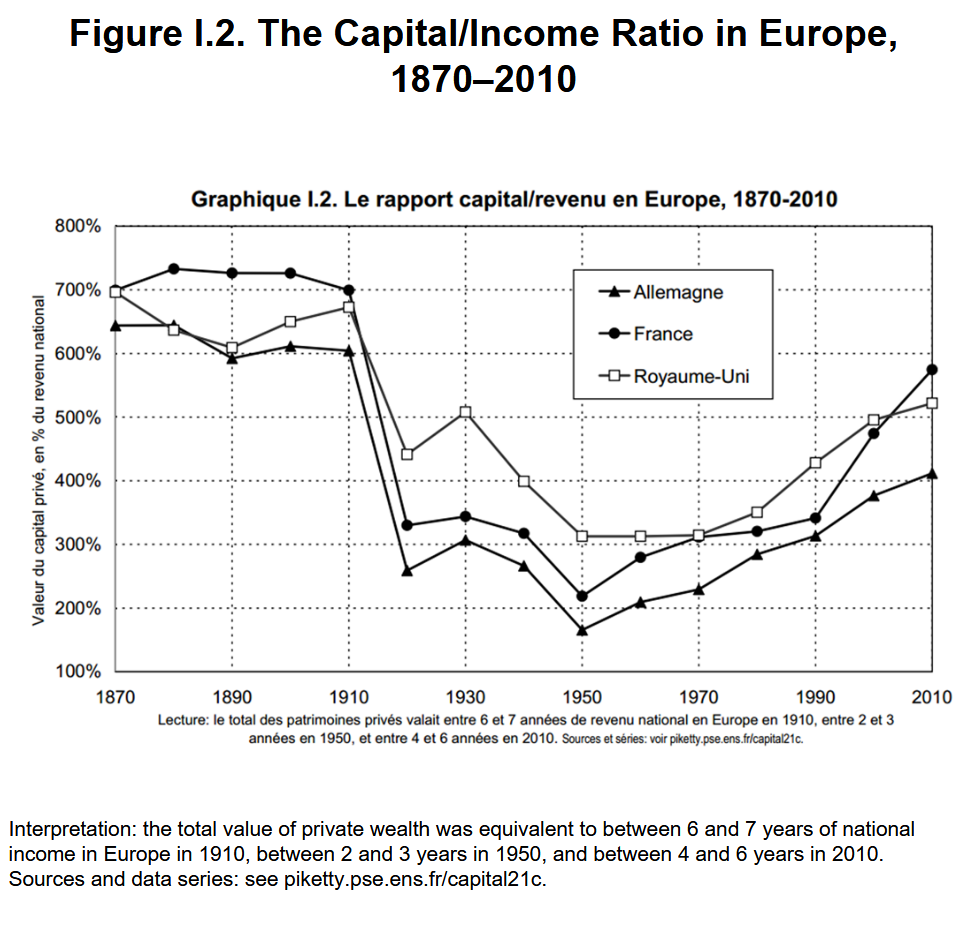
In the nineteenth century, the capital/national income ratio reached approximately 700% in European countries. The destructions of the two world wars—bombardments, inflation, nationalizations—reduced this ratio to approximately 300% by 1950. Since then, it has been gradually rising and tends toward pre-war levels.
Empirical data confirm the magnitude of wealth inequalities. In France, the top decile holds approximately 60% of total wealth, while the bottom half holds only 5%. In the United States, concentration is even more pronounced. Moreover, approximately 60% of large fortunes are inherited rather than accumulated over a working life.
Contemporary Mutations: Human, Digital, and Financial Capital
Contemporary capital takes unprecedented forms that complicate traditional analytical categories.
Human capital, conceptualized by Becker (1964), designates the stock of skills, knowledge, and abilities embodied in individuals. Education and training constitute investments in human capital that generate returns in the form of increased income throughout working life. Unlike physical capital, human capital is inalienable—it cannot be sold separately from the person who possesses it.
Digital capital transforms behavioral data into productive assets. Zuboff (2019) analyzes under the term “surveillance capitalism” the systematic extraction of users’ digital traces and their conversion into marketable behavioral predictions. Google and Meta (formerly Facebook) illustrate this model where value is created by users but captured by platforms.
Financial capital has undergone increasing sophistication. Derivatives now represent a notional equivalent to more than ten times world GDP. Algorithmic transactions occur in microseconds. Capital tends to dematerialize into pure information, sometimes disconnected from the real productive sphere.
These developments blur the boundary between labor and capital. A Silicon Valley developer combines both dimensions: a worker producing code, they simultaneously constitute rare human capital whose returns increase with experience. A YouTube content creator provides permanent production labor while accumulating reputational capital generating passive income.
3.6 Political Implications of the Capital Question
The question of capital extends beyond positive economic analysis to invest the fields of political philosophy and social ethics. Who should own capital? How should its returns be taxed? What redistribution is legitimate?
Piketty (2019) proposes the establishment of a global capital tax to counteract the tax optimization strategies enabled by international mobility of wealth. Other authors advocate extending collective ownership through pension funds, employee share ownership, or cooperatives.
The ecological crisis adds a further dimension to these debates. Natural capital—stable climate, biodiversity, non-renewable resources—is undergoing accelerated erosion. Accounting for these destructions and building a sustainable economy constitute major challenges for the coming decades.