Advanced Innovation & entrepreneurship
-
Introduction
-
MODULE 1: CAPITAL, VALUE, AND ORGANIZATION
Unit 1 Value Creation, the production results2 Topics|1 Quiz -
Unit 2 What is the capital and how is it build ?2 Topics|1 Quiz
-
Unit 3 : Division and organisation of Labor3 Topics|1 Quiz
-
Unit 4 : Capturing and Retaining Created Value2 Topics|1 Quiz
-
Unit 5 : Value chains and their fragmentation, maximizing the value captured2 Topics|1 Quiz
-
MODULE 2: INNOVATION AS A SOCIAL PROCESSUnit 6 : Adoption, a frontier between invention and innovation2 Topics|1 Quiz
-
Unit 7 : Innovation as a social process2 Topics|1 Quiz
-
Unit 8 : Location and Links in innovation3 Topics|1 Quiz
-
Unit 9 : Innovation process between companies2 Topics|1 Quiz
-
Unit 10 : The case of Knowledge industries3 Topics|1 Quiz
-
Unit 11: Values typologie2 Topics|1 Quiz
-
Unit 12 : Innovation as a process of value proposal3 Topics|1 Quiz
-
MODULE 3: DIGITAL TRANSFORMATION, INTANGIBLE CAPITAL AND RESPONSIBILITYUnit 13 : Digital transformation2 Topics|1 Quiz
-
Unit 14 : Intangible capital role in Innovation4 Topics|1 Quiz
-
Unit 15 : Public investment generating positive externalities in service of innovation3 Topics|1 Quiz
-
Unit 16 : Corporate social and environmental responsibility in an innovation context2 Topics|1 Quiz
-
Unit 17 : Innovative management methods of companies2 Topics|1 Quiz
-
Conclusion and ReferencesGeneral Conclusion
-
Bibliographic references
-
Final Assessment1 Quiz

Use the Listen button to hear the transcript. You can pause and resume the audio, and stop it at any time.
Note: You need to mute the video to hear the transcript in other languages instead of English or it will overlap with the video audio.
Please also keep in mind not all languages are supported by the TTS engine.
Origins and Components of the Concept
Human capital is not a new idea. One can trace it back to Adam Smith. But the modern concept comes from Schultz and Becker in the 1960s. They showed that education, training, and even health are forms of investment, and that these investments can be measured and studied economically.
Human capital is intangible. It is not a machine or a building. But it is still a central resource in value creation.
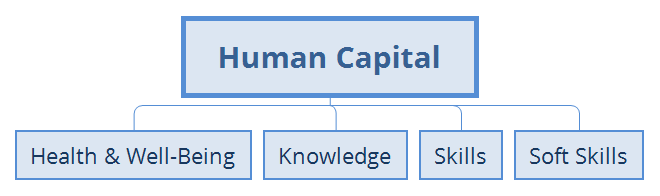
Human capital is usually described with several components: knowledge (e.g., academic learning); know-how (technical skills, job-related or not); interpersonal skills (knowing how to behave, communicate, and work with others); physical and mental health (illness, aging, or parenthood can also have a major impact).
Modes of Construction
We build this capital in many ways: through initial education, through continuing training (inside or outside companies), and through experience that shapes skills over time.
Forms of Strategic Investment
Investment in human capital is strategic and can take several forms.
Education: states that invest in schools and universities aim to raise national levels of knowledge and skills.
Corporate investment: companies invest through continuing training and also through policies that improve well-being at work. These actions strengthen human capital.
Public health: good health policies protect human capital. The absence of such policies negatively affects it. For example, low life expectancy increases the relative cost of training, because expected benefits shrink.
Migration: migration is also a transfer of human capital. “Brain drain” can be a loss for the country that sees people leave and a gain for the country that welcomes them.