Advanced Innovation & entrepreneurship
-
Introduction
-
MODULE 1: CAPITAL, VALUE, AND ORGANIZATION
Unit 1 Value Creation, the production results2 Topics|1 Quiz -
Unit 2 What is the capital and how is it build ?2 Topics|1 Quiz
-
Unit 3 : Division and organisation of Labor3 Topics|1 Quiz
-
Unit 4 : Capturing and Retaining Created Value2 Topics|1 Quiz
-
Unit 5 : Value chains and their fragmentation, maximizing the value captured2 Topics|1 Quiz
-
MODULE 2: INNOVATION AS A SOCIAL PROCESSUnit 6 : Adoption, a frontier between invention and innovation2 Topics|1 Quiz
-
Unit 7 : Innovation as a social process2 Topics|1 Quiz
-
Unit 8 : Location and Links in innovation3 Topics|1 Quiz
-
Unit 9 : Innovation process between companies2 Topics|1 Quiz
-
Unit 10 : The case of Knowledge industries3 Topics|1 Quiz
-
Unit 11: Values typologie2 Topics|1 Quiz
-
Unit 12 : Innovation as a process of value proposal3 Topics|1 Quiz
-
MODULE 3: DIGITAL TRANSFORMATION, INTANGIBLE CAPITAL AND RESPONSIBILITYUnit 13 : Digital transformation2 Topics|1 Quiz
-
Unit 14 : Intangible capital role in Innovation4 Topics|1 Quiz
-
Unit 15 : Public investment generating positive externalities in service of innovation3 Topics|1 Quiz
-
Unit 16 : Corporate social and environmental responsibility in an innovation context2 Topics|1 Quiz
-
Unit 17 : Innovative management methods of companies2 Topics|1 Quiz
-
Conclusion and ReferencesGeneral Conclusion
-
Bibliographic references
-
Final Assessment1 Quiz

Use the Listen button to hear the transcript. You can pause and resume the audio, and stop it at any time.
Note: You need to mute the video to hear the transcript in other languages instead of English or it will overlap with the video audio.
Please also keep in mind not all languages are supported by the TTS engine.
Moore’s Law and Permanent Innovation
In 1965, Gordon Moore predicted that the number of transistors on a chip would double every two years. This “Moore’s Law” has paced sixty years of computer innovation. But the computer industry is not reducible to a technological race. It is a complex ecosystem where hardware, software, and services intertwine. How does this industry organize permanent innovation?
Organization in Interdependent Layers
The computer industry is organized in interdependent layers, each with its innovation logic:
The hardware layer: semiconductors, components, devices. Capitalistic innovation—a chip fab costs twenty billion dollars. TSMC in Taiwan produces 92% of the most advanced chips.
The software layer: operating systems, applications, services. Innovation through rapid iteration—Google updates Chrome every six weeks.
The data layer: storage, processing, analysis. Innovation through scale effect—Amazon manages a third of global cloud.
Baldwin and Clark (2000), in Design Rules, show how this modularity enables distributed innovation: each layer can evolve independently while remaining compatible.
Contrasting Innovation Models
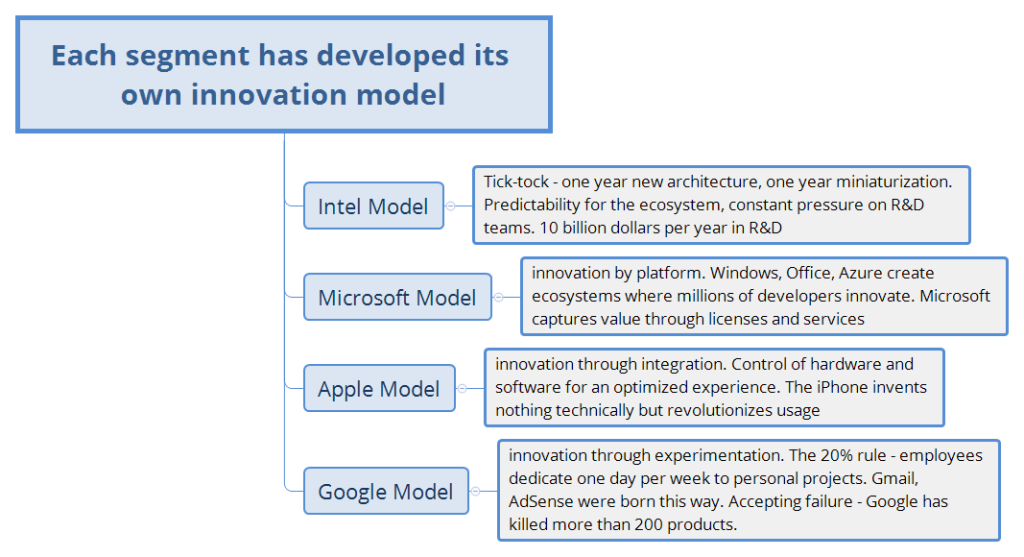
Each segment has developed its own innovation model:
The Intel model: innovation by roadmap. One year, new architecture; one year, more miniaturization. Predictability for the ecosystem, constant pressure on R&D teams. Ten billion dollars per year in R&D.
The Microsoft model: innovation by platform. Windows, Office, Azure create ecosystems where millions of developers innovate. Microsoft captures value through licenses and services.
The Apple model: innovation through integration. Control of hardware and software for an optimized experience. The iPhone invents nothing technically but changes usage.
The Google model: innovation through experimentation. The 20% rule—employees dedicate one day per week to personal projects. Gmail, AdSense were born this way. Acceptance of failure—Google has killed more than 200 products.
Each model reflects a different philosophy: technical excellence (Intel), ecosystem (Microsoft), experience (Apple), exploration (Google).
Permanent Disruption
The computer industry experiences permanent disruption:
Accelerated technological cycles: mainframes, minicomputers, mobile, cloud… Each wave destroys previous leaders. IBM dominated mainframes, invisible in mobile. Nokia, mobile leader, disappears with smartphones.
Architectural innovation: Apple Silicon shows that forty years of Intel dominance can be challenged. ARM, which manufactures nothing but licenses its designs, disrupts the industry.
Software eating the world: Marc Andreessen was right. Software companies cannibalize hardware companies. Spotify destroys the CD industry, Netflix the DVD industry, Tesla is as much a software company as a car company.
Christensen and Raynor (2003), in The Innovator’s Solution, analyze how these disruptions follow predictable patterns: start from the low end or non-consumers, then move upmarket.
Particular Economy of Computer Innovation
Computer innovation has a particular economy:
Near-zero marginal costs: duplicating software costs nothing. WhatsApp served 900 million users with 55 engineers. This economy favors “winner-take-all” effects.
Network effects: value grows with the number of users. Facebook is worth little with 1,000 users, becomes indispensable with 3 billion. These effects create natural monopolies difficult to replace.
Technical debt: rapid innovation creates technical debt. Legacy systems become impossible to maintain. COBOL, a 1960s language, still runs 70% of banking transactions. Future innovation is constrained by past choices.
Open source as infrastructure: Linux, Apache, Kubernetes… Competitors collaborate on infrastructure, compete on services. Even Microsoft, the proprietary champion, contributes massively to open source.
The computer industry has created a unique innovation model: fast, modular, disruptive.