
Advanced Innovation & entrepreneurship
-
Introduction
-
MODULE 1: CAPITAL, VALUE, AND ORGANIZATION
Unit 1 Value Creation, the production results2 Topics|1 Quiz -
Unit 2 What is the capital and how is it build ?2 Topics|1 Quiz
-
Unit 3 : Division and organisation of Labor3 Topics|1 Quiz
-
Unit 4 : Capturing and Retaining Created Value2 Topics|1 Quiz
-
Unit 5 : Value chains and their fragmentation, maximizing the value captured2 Topics|1 Quiz
-
MODULE 2: INNOVATION AS A SOCIAL PROCESSUnit 6 : Adoption, a frontier between invention and innovation2 Topics|1 Quiz
-
Unit 7 : Innovation as a social process2 Topics|1 Quiz
-
Unit 8 : Location and Links in innovation3 Topics|1 Quiz
-
Unit 9 : Innovation process between companies2 Topics|1 Quiz
-
Unit 10 : The case of Knowledge industries3 Topics|1 Quiz
-
Unit 11: Values typologie2 Topics|1 Quiz
-
Unit 12 : Innovation as a process of value proposal3 Topics|1 Quiz
-
MODULE 3: DIGITAL TRANSFORMATION, INTANGIBLE CAPITAL AND RESPONSIBILITYUnit 13 : Digital transformation2 Topics|1 Quiz
-
Unit 14 : Intangible capital role in Innovation4 Topics|1 Quiz
-
Unit 15 : Public investment generating positive externalities in service of innovation3 Topics|1 Quiz
-
Unit 16 : Corporate social and environmental responsibility in an innovation context2 Topics|1 Quiz
-
Unit 17 : Innovative management methods of companies2 Topics|1 Quiz
-
Conclusion and ReferencesGeneral Conclusion
-
Bibliographic references
-
Final Assessment1 Quiz

Use the Listen button to hear the transcript. You can pause and resume the audio, and stop it at any time.
Note: You need to mute the video to hear the transcript in other languages instead of English or it will overlap with the video audio.
Please also keep in mind not all languages are supported by the TTS engine.
Three Organizational Paradigms
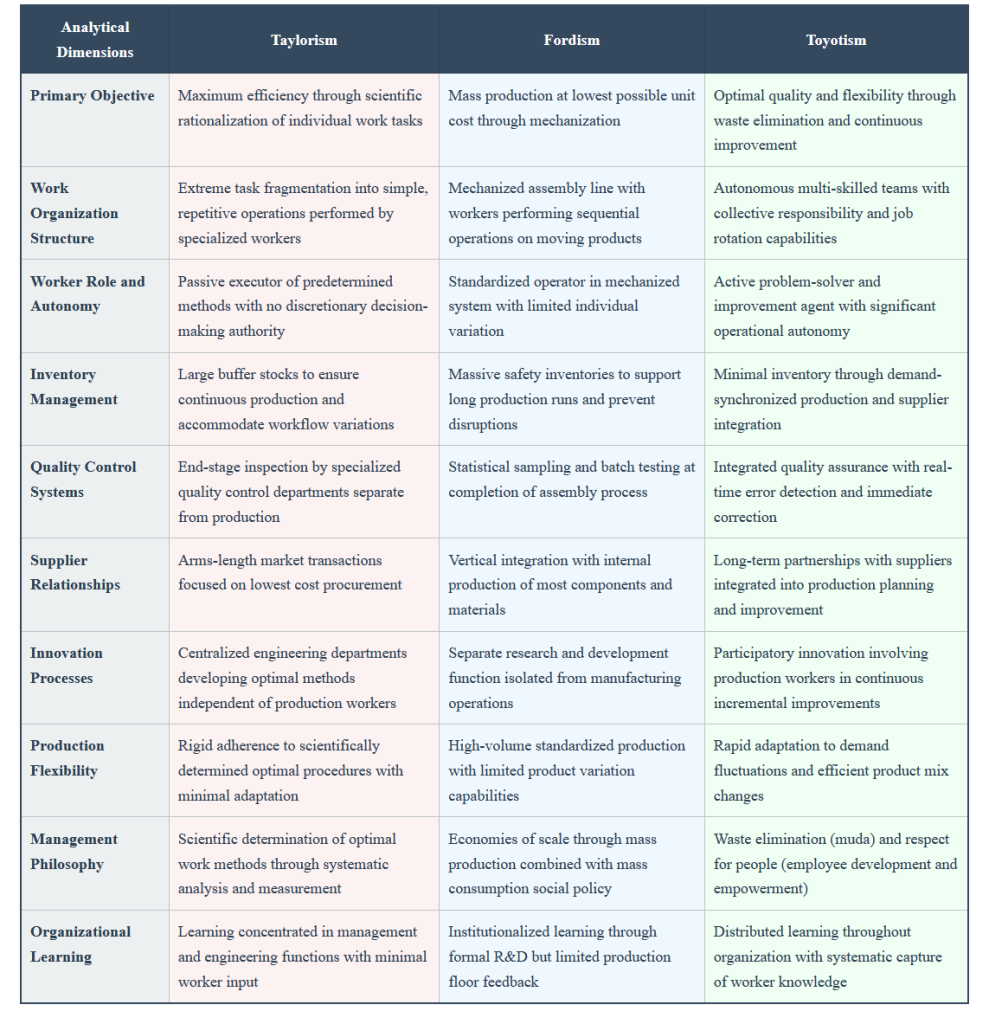
Three major paradigms have structured industrial work organization during the twentieth century: Taylorism, Fordism, and Toyotism. These models do not succeed each other linearly; they coexist, hybridize, and evolve according to sectoral and national contexts.
Fordism as a Regime of Accumulation
Fordism exceeds the purely organizational dimension to constitute a veritable regime of accumulation, according to the terminology of regulation school.
Beyond Taylorian work organization, Ford innovates by establishing a link between mass production and mass consumption. The decision to double wages in 1914—the famous “Five Dollar Day”—translates this intuition: workers are also consumers. Well-paid workers constitute an outlet for standardized production.
Fordism thus articulates three dimensions:
- Work organization: Taylorism, assembly line, standardization.
- Wage relation: employment stability, wage progression indexed to productivity, social protection.
- Mode of regulation: state intervention, collective bargaining, Keynesian demand-support policies.
This “Fordist compromise” structured Western economies during the Thirty Glorious Years (1945-1975). Work remains alienating, but material security increases, consumption is democratized, and the welfare state extends.
The Crisis of Fordism and the Emergence of Toyotism
Beginning in the 1970s, the Fordist regime enters into crisis. The saturation of standardized goods markets, consumer demand for variety, and intensifying international competition reveal the model’s rigidities.
The Toyota Production System (TPS), developed by engineer Taiichi Ohno, proposes an alternative. Its guiding principle reverses Fordist logic: instead of producing then selling, the aim is to sell then produce. This is just-in-time: production is pulled by actual demand, not pushed by supply capacity.
Toyotism rests on several interdependent principles:
Flexibility: Operators are versatile, equipment programmable. Production can quickly adapt to quantitative and qualitative demand fluctuations.
Waste elimination (muda): Lean management aims for “zero inventory, zero defects, zero delays.” In this perspective, inventory is not security but a symptom of dysfunction that should be eliminated to reveal and solve problems.
Continuous improvement (kaizen): Operators are involved in process optimization through quality circles. Worker intelligence, denied by Taylorism, is mobilized in service of productivity.
Paradoxes and Tensions of Toyotism
Toyotism presents ambivalent characteristics. On one hand, it recognizes skills, values versatility, and flattens hierarchies. On the other, it intensifies work: elimination of downtime, permanent pressure from just-in-time flows, stress linked to reactivity demands.
The autonomy granted to operators remains instrumental: it serves the objective of increasing productivity. As labor sociologists have analyzed (Durand, 2004), this “controlled autonomy” can engender new forms of domination, all the more effective because they rely on workers’ subjective engagement.
Toyotism also transforms inter-firm relations. Where Ford integrated vertically, Toyota outsources massively while maintaining tight control over subcontractors. The keiretsu—pyramidal supplier networks—maintain long-term relationships, share risks and gains, and co-develop products. The division of labor crosses the firm’s legal boundaries.
Hybridizations and Emerging Models
Contemporary models present a hybrid character. Amazon, for example, combines rigorous Taylorism in its logistics warehouses with sophisticated algorithmic personalization of the customer experience. A single organization may apply differentiated logics across its activities.
New models are emerging. The liberated company eliminates intermediate hierarchical levels and grants broad autonomy to teams. At Gore-Tex, there are no formal hierarchical superiors; teams self-organize around projects. This model paradoxically evokes pre-Taylorian forms of craftsmanship but relies on modern coordination technologies.
Digital platforms (Uber, Airbnb, Deliveroo) push outsourcing to its limit. They retain algorithmic control and the customer relationship; they outsource all operational work to formally independent workers. This model raises major questions regarding social protection and the legal qualification of work.
A Structural Tension
These different models manage the same fundamental tension: how to effectively coordinate collective work? Taylor relies on methods science, Ford on standardization and high wages, Ohno on guided autonomy, platforms on algorithms.
The normative question remains open: how can work be organized efficiently while respecting the people who perform it? This question is not merely technical or economic; it is profoundly political and ethical.