
Advanced Innovation & entrepreneurship
-
Introduction
-
MODULE 1: CAPITAL, VALUE, AND ORGANIZATION
Unit 1 Value Creation, the production results2 Topics|1 Quiz -
Unit 2 What is the capital and how is it build ?2 Topics|1 Quiz
-
Unit 3 : Division and organisation of Labor3 Topics|1 Quiz
-
Unit 4 : Capturing and Retaining Created Value2 Topics|1 Quiz
-
Unit 5 : Value chains and their fragmentation, maximizing the value captured2 Topics|1 Quiz
-
MODULE 2: INNOVATION AS A SOCIAL PROCESSUnit 6 : Adoption, a frontier between invention and innovation2 Topics|1 Quiz
-
Unit 7 : Innovation as a social process2 Topics|1 Quiz
-
Unit 8 : Location and Links in innovation3 Topics|1 Quiz
-
Unit 9 : Innovation process between companies2 Topics|1 Quiz
-
Unit 10 : The case of Knowledge industries3 Topics|1 Quiz
-
Unit 11: Values typologie2 Topics|1 Quiz
-
Unit 12 : Innovation as a process of value proposal3 Topics|1 Quiz
-
MODULE 3: DIGITAL TRANSFORMATION, INTANGIBLE CAPITAL AND RESPONSIBILITYUnit 13 : Digital transformation2 Topics|1 Quiz
-
Unit 14 : Intangible capital role in Innovation4 Topics|1 Quiz
-
Unit 15 : Public investment generating positive externalities in service of innovation3 Topics|1 Quiz
-
Unit 16 : Corporate social and environmental responsibility in an innovation context2 Topics|1 Quiz
-
Unit 17 : Innovative management methods of companies2 Topics|1 Quiz
-
Conclusion and ReferencesGeneral Conclusion
-
Bibliographic references
-
Final Assessment1 Quiz

Use the Listen button to hear the transcript. You can pause and resume the audio, and stop it at any time.
Note: You need to mute the video to hear the transcript in other languages instead of English or it will overlap with the video audio.
Please also keep in mind not all languages are supported by the TTS engine.
The WhatsApp Acquisition: An Emblematic Case
In 2014, Facebook buys WhatsApp for nineteen billion dollars. At the time, WhatsApp has only fifty-five employees. This is not a classic acquisition. Facebook is not buying a product; it is buying an innovation it could not build internally.
This example reveals a trend: large companies increasingly outsource innovation to startups.
The Paradox of Large Companies
Large companies face a paradox. They have considerable resources: substantial R&D budgets, talented engineers, powerful infrastructures. But they struggle to change and create radical innovation.
This paradox was explained in 1997 by Clayton Christensen in The Innovator’s Dilemma. The idea is simple: what makes firms efficient also makes them rigid. Good managers optimize existing models. They reduce risk. They follow what already works. But breakthrough innovation requires experimentation and acceptance of failure.
Large organizations therefore move slowly. They have more inertia, more constraints than startups.
Structural Advantages of Startups
Startups possess structural advantages for certain types of innovation:
Agility: startups are small and young. They have few rigid processes. Decisions are fast. Pivots are possible. Spotify changed its model several times before finding subscription streaming.
Focus: a startup generally pursues a single goal. It does one thing, obsessively. Zoom focused only on video quality while Skype managed multiple priorities.
Risk tolerance: a startup can bet everything on uncertain technology. Failure is part of the game. Large firms cannot do this; they must reassure shareholders every quarter.
Mechanisms for Capturing Startup Innovation
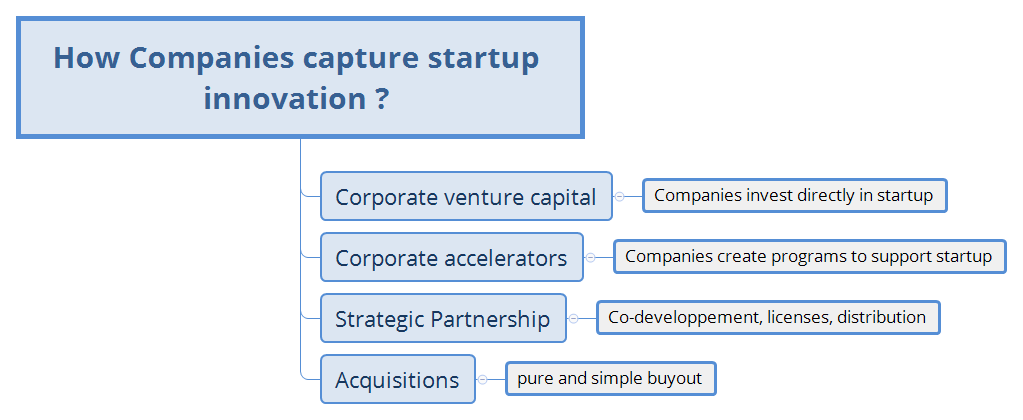
To capture startup innovation, companies use several mechanisms:
Corporate venture capital: firms invest directly in startups. Google Ventures manages billions and hundreds of investments. Some bets fail; others transform industries.
Corporate accelerators: companies run startup programs. They offer mentoring, resources, and access to customers. In return, they observe innovation early.
Strategic partnerships: startups and firms co-develop solutions. They share licenses or distribute together. Each startup brings a capability—logistics, payments, personalization.
Acquisitions: the firm simply buys the startup. Microsoft did this multiple times—GitHub, LinkedIn. This is “plug and play” innovation: buying what one cannot build.
Open Innovation According to Chesbrough
This logic was theorized in 2003 by Henry Chesbrough under the term open innovation. The idea is clear: company boundaries become porous. Innovation flows in both directions.
Firms can use external ideas. They can also externalize unused ideas. Or combine both approaches.
This contrasts with the old model where R&D remained internal and tightly controlled. Now, collaboration matters. Partnerships, cross-licenses, co-development.
According to Chesbrough, this model is no longer optional. Talent moves faster. Knowledge is dispersed. Technology evolves rapidly. Innovation becomes distributed and collaborative.
Difficulties of Outsourcing Innovation
But outsourcing innovation is not easy. It creates major difficulties:
Culture: startups value speed and informality; large firms value process and hierarchy. Many acquisitions fail because cultures do not match.
Scaling: what works in a startup may fail at large scale. Compliance, security, system integration—these constraints can kill innovation.
People: after acquisition, founders often leave. Key teams leave as well. With them goes the innovative spirit.
Integration: the organization may reject innovation. Managers may feel threatened. Processes may suffocate new ideas.
Toward a New Paradigm
To address these challenges, new models appear. Venture builders create startups in series. Startup studios co-found with entrepreneurs. Large firms no longer merely buy innovation; they help create it from the start.
Outsourcing innovation to startups reveals a deeper shift. Innovation is no longer internal. It is open, distributed, and orchestrated. Company boundaries blur. Innovation capacity changes meaning.
The key question evolves: no longer “how do we innovate?” but “how do we orchestrate others’ innovation?“