Advanced Innovation & entrepreneurship
-
Introduction
-
MODULE 1: CAPITAL, VALUE, AND ORGANIZATION
Unit 1 Value Creation, the production results2 Topics|1 Quiz -
Unit 2 What is the capital and how is it build ?2 Topics|1 Quiz
-
Unit 3 : Division and organisation of Labor3 Topics|1 Quiz
-
Unit 4 : Capturing and Retaining Created Value2 Topics|1 Quiz
-
Unit 5 : Value chains and their fragmentation, maximizing the value captured2 Topics|1 Quiz
-
MODULE 2: INNOVATION AS A SOCIAL PROCESSUnit 6 : Adoption, a frontier between invention and innovation2 Topics|1 Quiz
-
Unit 7 : Innovation as a social process2 Topics|1 Quiz
-
Unit 8 : Location and Links in innovation3 Topics|1 Quiz
-
Unit 9 : Innovation process between companies2 Topics|1 Quiz
-
Unit 10 : The case of Knowledge industries3 Topics|1 Quiz
-
Unit 11: Values typologie2 Topics|1 Quiz
-
Unit 12 : Innovation as a process of value proposal3 Topics|1 Quiz
-
MODULE 3: DIGITAL TRANSFORMATION, INTANGIBLE CAPITAL AND RESPONSIBILITYUnit 13 : Digital transformation2 Topics|1 Quiz
-
Unit 14 : Intangible capital role in Innovation4 Topics|1 Quiz
-
Unit 15 : Public investment generating positive externalities in service of innovation3 Topics|1 Quiz
-
Unit 16 : Corporate social and environmental responsibility in an innovation context2 Topics|1 Quiz
-
Unit 17 : Innovative management methods of companies2 Topics|1 Quiz
-
Conclusion and ReferencesGeneral Conclusion
-
Bibliographic references
-
Final Assessment1 Quiz
Knowledge Industries—The Pharmaceutical Example

Alvaro Pina Stranger 04/11/2026
Use the Listen button to hear the transcript. You can pause and resume the audio, and stop it at any time.
Note: You need to mute the video to hear the transcript in other languages instead of English or it will overlap with the video audio.
Please also keep in mind not all languages are supported by the TTS engine.
The Centrality of Information Production
As established in the first module, intangible assets now dominate the economy. In this logic, information production becomes central. The pharmaceutical industry constitutes a paradigmatic example.
Developing a new drug costs approximately 2.6 billion dollars. It takes about twelve years. Out of ten thousand molecules tested, only one reaches the market. This observation illustrates a paradox: colossal investments, enormous risks, but also vital social value.
The Blockbuster Model
For decades, the pharmaceutical industry used the blockbuster model—drugs generating over one billion dollars annually. Lipitor (Pfizer) generated approximately 125 billion dollars over its lifetime.
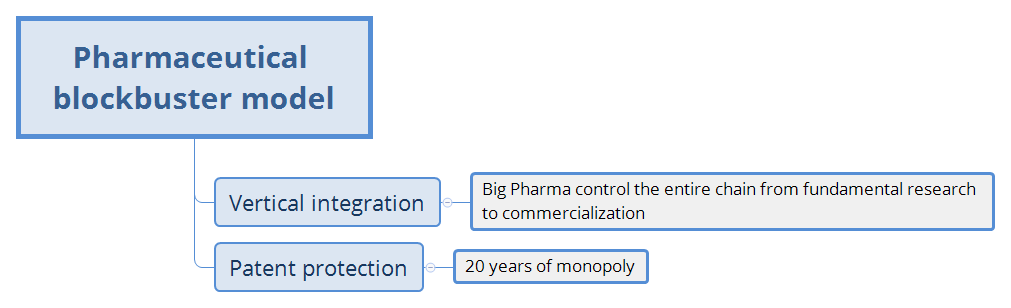
This model rests on two pillars:
Vertical integration: Big Pharma controls everything, from basic research to market launch. Novartis employs approximately fifteen thousand researchers. Roche invests approximately fourteen billion per year.
Patent protection: approximately twenty years of monopoly to recover investments. The race begins early, often before clinical trials.
And let us remember: failure is normal. For one success, dozens fail. But all failures are financed.
Pisano (2006) calls this a science business: value lies in knowledge, but transforming knowledge into products is slow and costly.
Crisis of the Model and New Strategies
Today, R&D productivity is declining. Larger budgets, fewer new drugs. The model had to change.
Like other industries, pharma outsources, particularly early research. Big Pharma becomes an orchestrator. AstraZeneca closed its basic research laboratories to focus on development. Universities and biotechs do the upstream work.
Another strategy appears: do not search, buy. Gilead bought Pharmasset for eleven billion and obtained Sofosbuvir. Return: fifty-eight billion in five years.
Partnerships also grow, sharing risks and skills. The Pfizer-BioNTech vaccine is a clear case: BioNTech brings mRNA, Pfizer brings clinical trials and large-scale production.
Personalization is also observed. No more one-size-fits-all. Drugs target subgroups. Herceptin works for only 20% of patients, but it changes survival.
Geography of Pharmaceutical Innovation
Pharmaceutical innovation also moves in space.
Biotechnology clusters develop. Boston-Cambridge is key: approximately one thousand firms, fifty thousand jobs. MIT, Harvard, hospitals. People circulate constantly—university, startup, Big Pharma.
Asia rises. China becomes a major player. WuXi AppTec offers R&D as a service—like an Amazon of pharma. Clinical trials also move: 60% are now abroad—India, Brazil, Eastern Europe. Lower costs, more diverse patients.
Digital Disruption
Digital tools now disrupt pharma.
AI in drug discovery: AlphaFold predicts proteins. Years become hours. Atomwise virtually screens millions of molecules.
Digital trials: sensors, apps, remote monitoring. Costs drop by 30%. Recruitment is faster.
Real-world evidence: medical records, insurance data show real effectiveness. But problems appear: data ownership, consent, bias.
Tensions and Challenges
The model is under tension. Drug prices explode. Zolgensma costs over two million dollars. Access becomes difficult. The pandemic showed limits: patents slowed vaccines.
Innovation must balance profit and public good. The pharmaceutical industry illustrates the central challenge: knowledge is powerful, but costly, risky, and ethically charged. The model evolves toward more openness, more collaboration, more digital tools.