
Advanced Innovation & entrepreneurship
-
Introduction
-
MODULE 1: CAPITAL, VALUE, AND ORGANIZATION
Unit 1 Value Creation, the production results2 Topics|1 Quiz -
Unit 2 What is the capital and how is it build ?2 Topics|1 Quiz
-
Unit 3 : Division and organisation of Labor3 Topics|1 Quiz
-
Unit 4 : Capturing and Retaining Created Value2 Topics|1 Quiz
-
Unit 5 : Value chains and their fragmentation, maximizing the value captured2 Topics|1 Quiz
-
MODULE 2: INNOVATION AS A SOCIAL PROCESSUnit 6 : Adoption, a frontier between invention and innovation2 Topics|1 Quiz
-
Unit 7 : Innovation as a social process2 Topics|1 Quiz
-
Unit 8 : Location and Links in innovation3 Topics|1 Quiz
-
Unit 9 : Innovation process between companies2 Topics|1 Quiz
-
Unit 10 : The case of Knowledge industries3 Topics|1 Quiz
-
Unit 11: Values typologie2 Topics|1 Quiz
-
Unit 12 : Innovation as a process of value proposal3 Topics|1 Quiz
-
MODULE 3: DIGITAL TRANSFORMATION, INTANGIBLE CAPITAL AND RESPONSIBILITYUnit 13 : Digital transformation2 Topics|1 Quiz
-
Unit 14 : Intangible capital role in Innovation4 Topics|1 Quiz
-
Unit 15 : Public investment generating positive externalities in service of innovation3 Topics|1 Quiz
-
Unit 16 : Corporate social and environmental responsibility in an innovation context2 Topics|1 Quiz
-
Unit 17 : Innovative management methods of companies2 Topics|1 Quiz
-
Conclusion and ReferencesGeneral Conclusion
-
Bibliographic references
-
Final Assessment1 Quiz

Use the Listen button to hear the transcript. You can pause and resume the audio, and stop it at any time.
Note: You need to mute the video to hear the transcript in other languages instead of English or it will overlap with the video audio.
Please also keep in mind not all languages are supported by the TTS engine.
Creation and Capture: A Fundamental Analytical Distinction
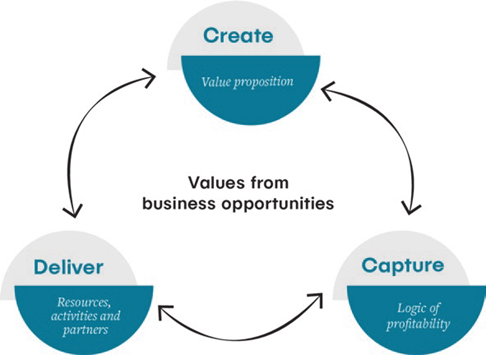
Previous chapters examined value creation processes. But creating value does not guarantee keeping it. This is why it is appropriate to analytically distinguish value creation—the provision of new utility—from value capture—the appropriation of the benefits of this creation.
Facebook’s acquisition of WhatsApp for $19 billion in 2014, when the application generated only $20 million in revenue, spectacularly illustrates the gap between value created and value captured by the initial innovator.
Teece’s Analytical Framework: Appropriability Regimes and Complementary Assets
David Teece (1986), in his foundational article “Profiting from Technological Innovation,” theorized the conditions under which innovators succeed—or fail—to capture the value created by their innovation.
Two factors determine value distribution:
- Appropriability regime: To what extent can the innovation be protected from imitation? A solid patent, a difficult-to-penetrate trade secret, or a significant technological lead constitute effective protections. Conversely, an easily imitable innovation will see its value captured by followers.
- Complementary assets: To transform an innovation into profits, one generally needs to control adjacent assets—production capacity, distribution network, sales force, brand image. Whoever controls these complementary assets can capture a substantial share of value, even if they are not the innovator.
Xerox invented the graphical interface; Apple, which mastered the complementary assets necessary for mass-market commercialization, profited from it with the Macintosh. Bell Labs invented the transistor; Intel, which invested massively in production capacity, built the semiconductor industry.
The Kodak Case: When the Innovator Destroys Their Own Model
The Kodak case illustrates a paradoxical configuration. The company dominated film photography, deriving most of its revenue from film sales. Kodak helped invent digital photography—but this innovation, by eliminating the need for film, destroyed precisely the source of its profits. The practice of photography multiplied; Kodak went bankrupt.
This case illustrates the innovator’s dilemma theorized by Christensen (1997): the established firm may be unable to fully commit to a disruptive innovation that would cannibalize its existing business.
Price as a Direct Capture Mechanism
Price constitutes the most direct mechanism of value capture. As Porter (1985) analyzed, the ability to maintain high prices depends on market power and perceived differentiation.
Apple illustrates this strategy. The production cost of an iPhone is approximately $500; the selling price reaches $1,100, a gross margin of approximately 54%. Competitors, on technically comparable products, achieve margins of around 20%. Apple captures value through multidimensional differentiation: brand, design, service ecosystem, user experience.
Price Discrimination and Segmentation
Price discrimination refines capture by adapting price to each customer segment’s willingness to pay. Airlines systematically practice this strategy: the same seat can be priced at €200 or €2,000 depending on booking date, flexibility conditions, and associated services. Each segment pays a price close to its reservation price.
The freemium model extends this logic to digital. Spotify offers a free ad-supported version and a paid ad-free version. Of 515 million users, 210 million subscribe to the paid plan. Free users contribute to network expansion and data collection; paying users generate most of the revenue.
The shift from sales to subscription modifies capture dynamics. Adobe marketed Photoshop for approximately $700; Creative Cloud is now billed monthly at approximately $60. Over time, users pay more, but periodic amounts appear more acceptable. Adobe’s revenue quadrupled in ten years through this transition.
Platforms and Control of Obligatory Passage Points
Beyond price, firms capture value by controlling strategic resources or obligatory passage points. This is the logic of digital platforms, theorized notably by Rochet and Tirole (2003) within the framework of two-sided markets.
Amazon Marketplace illustrates this dynamic. Third-party sellers account for 60% of total sales. Amazon takes 30-45% of these sales in the form of commissions, advertising services, and logistics fees. Amazon controls access to consumers; sellers create the offering.
Google and Meta push this logic further. Users create content (searches, posts, interactions), advertisers pay to access the attention thus captured, and platforms appropriate the value. Meta generates approximately $60 in annual advertising revenue per American user. Users receive nothing.
Apple takes 30% of all transactions made through the App Store. This commission generated $85 billion in 2022—more than Nike’s revenue. Developers create the applications; Apple controls access to iOS users.
Toward Alignment Between Creation and Capture?
Porter and Kramer (2011) propose the concept of “shared value” (creating shared value) to think about the articulation between value creation and capture. Their thesis: firms that align their business model with solving social problems generate more sustainable value.
When the gap between creation and capture becomes excessive, dysfunctions appear. Socially important innovations fail to find viable business models. Predatory capture behaviors develop without creation. The social legitimacy of capitalism erodes.
The issue is not to eliminate value capture—it is necessary to finance investment and reward risk—but to align it with the effective creation of value for society.