
Advanced Innovation & entrepreneurship
-
Introduction
-
MODULE 1: CAPITAL, VALUE, AND ORGANIZATION
Unit 1 Value Creation, the production results2 Topics|1 Quiz -
Unit 2 What is the capital and how is it build ?2 Topics|1 Quiz
-
Unit 3 : Division and organisation of Labor3 Topics|1 Quiz
-
Unit 4 : Capturing and Retaining Created Value2 Topics|1 Quiz
-
Unit 5 : Value chains and their fragmentation, maximizing the value captured2 Topics|1 Quiz
-
MODULE 2: INNOVATION AS A SOCIAL PROCESSUnit 6 : Adoption, a frontier between invention and innovation2 Topics|1 Quiz
-
Unit 7 : Innovation as a social process2 Topics|1 Quiz
-
Unit 8 : Location and Links in innovation3 Topics|1 Quiz
-
Unit 9 : Innovation process between companies2 Topics|1 Quiz
-
Unit 10 : The case of Knowledge industries3 Topics|1 Quiz
-
Unit 11: Values typologie2 Topics|1 Quiz
-
Unit 12 : Innovation as a process of value proposal3 Topics|1 Quiz
-
MODULE 3: DIGITAL TRANSFORMATION, INTANGIBLE CAPITAL AND RESPONSIBILITYUnit 13 : Digital transformation2 Topics|1 Quiz
-
Unit 14 : Intangible capital role in Innovation4 Topics|1 Quiz
-
Unit 15 : Public investment generating positive externalities in service of innovation3 Topics|1 Quiz
-
Unit 16 : Corporate social and environmental responsibility in an innovation context2 Topics|1 Quiz
-
Unit 17 : Innovative management methods of companies2 Topics|1 Quiz
-
Conclusion and ReferencesGeneral Conclusion
-
Bibliographic references
-
Final Assessment1 Quiz
How to capture indirect and non-financial values?

Alvaro Pina Stranger 04/11/2026
Use the Listen button to hear the transcript. You can pause and resume the audio, and stop it at any time.
Note: You need to mute the video to hear the transcript in other languages instead of English or it will overlap with the video audio.
Please also keep in mind not all languages are supported by the TTS engine.
Beyond Direct Monetary Value
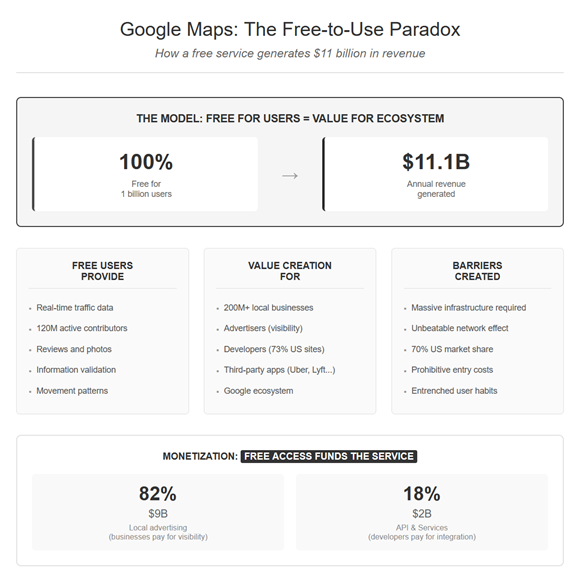
Contemporary business models go beyond direct monetary value capture. TikTok transforms the music industry without selling music—the platform propels artists through virality. Google Maps appears free—but generates massive flows of behavioral data. Behind apparently free services lie sophisticated value capture mechanisms.
Data as a Strategic Asset
Every digital interaction produces data. This data, aggregated and analyzed, constitutes a strategic asset that platforms monetize in multiple ways.
Zuboff (2019), in The Age of Surveillance Capitalism, analyzes this dynamic under the term “surveillance capitalism.” Users’ behavioral traces—searches, movements, purchases, social interactions—are extracted, processed, and converted into marketable behavioral predictions. Google derives approximately $8 in annual advertising revenue per Google Maps user, a service perceived as free.
Connected vehicles illustrate the magnitude of generated data flows. A contemporary car produces approximately 25 gigabytes of data per hour of driving. Tesla has accumulated more than 8 billion miles of driving data. Morgan Stanley values this database at $15 billion—more than the company’s industrial assets. The automobile becomes as much a data capture device as a means of transportation.
Amazon accepts losses on many products, but each transaction enriches its knowledge of purchasing behavior. This data enables refined demand forecasting, optimized inventory, and the design of private-label products. The Alexa voice assistant operates at a loss but captures detailed data on domestic habits.
The Attention Economy
Human attention constitutes a cognitively limited resource. Herbert Simon (1971) had anticipated this problematic: “In an information-rich world, the abundance of information engenders the scarcity of attention.” Digital platforms have made this intuition into a business model.
Netflix captures approximately three hours of daily attention per subscribing household. This capture creates habits, raises switching costs, and locks in subscribers. Attention is not merely a means of exposing advertising; it is itself an asset that locks in the customer relationship.
Social Capital and Influence as Assets
Bourdieu (1986) theorized social capital as the set of actual or potential resources linked to possession of a durable network of relationships. Digital platforms have made this capital partially monetizable.
A content creator with one million followers can charge $10,000 for a sponsored post. But the value of influence exceeds direct monetization: brand partnerships, paid training, exclusive access, professional opportunities.
Elon Musk embodies an extreme form of capture through influence. A simple message from him on social networks can move stock prices. This influence constitutes an asset that facilitates fundraising, stimulates pre-orders, and inflates valuations.
Externalization of Costs and Capture of Benefits
Coase (1960) theorized externalities as uncompensated effects that an economic activity imposes on third parties. Digital platforms have made cost externalization into a business model: they capture benefits and transfer costs to third parties—users, workers, communities.
Netflix generates revenue through subscriptions, but users also “pay” in time—and potentially in reduced well-being. Epidemiological studies associate intensive screen use with various pathologies. Health and social costs are not borne by the platforms that capture the benefits of attention.
Uber owns no vehicles but takes approximately 25% of each ride. Drivers bear all operating costs: fuel, insurance, maintenance, vehicle depreciation. An MIT study (2018) estimated that Uber had externalized tens of billions of dollars in costs to its drivers.
Airbnb reshapes urban economies. The platform removes housing from long-term rental markets, contributes to rent increases, and generates neighborhood nuisances. Municipalities must manage the consequences—housing crises, social tensions—while Airbnb keeps its commissions.
This externalization logic is spreading. Profits remain private; costs become social. Tech giants also optimize their taxes, paying on average 12% corporate tax while traditional firms pay 23% (OECD, 2021).
Lock-In as a Durable Capture Mechanism
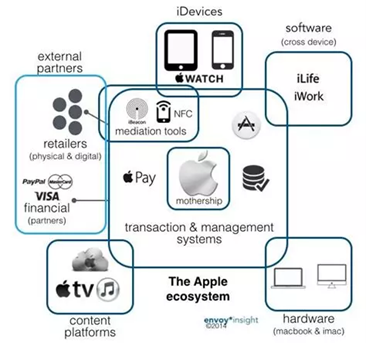
The most lasting capture occurs through user lock-in. Apple sells an integrated ecosystem: App Store, iCloud, AirPods, Apple Music, Apple Pay. Each additional service raises switching costs. Leaving the Apple ecosystem involves repurchasing applications, migrating data, and changing habits. Some estimates put this switching cost at $1,800.
Amazon Prime works on a similar logic. The service starts with free delivery, then aggregates video, music, gaming, and cloud storage. Each additional layer increases perceived value and switching costs. The annual renewal rate reaches 90%.
Regulatory Issues
As Stiglitz (2019) emphasizes, indirect value flows—data, attention, externalities—represent massive transfers that largely escape traditional categories of economic analysis and regulation.
The maxim “if it’s free, you’re the product” translates a correct but insufficient intuition. The challenge for regulators is to make these capture mechanisms visible and evaluate their social fairness. For nothing is truly free: all captured value comes from a source that must be identified.