Advanced Innovation & entrepreneurship
-
Introduction
-
MODULE 1: CAPITAL, VALUE, AND ORGANIZATION
Unit 1 Value Creation, the production results2 Topics|1 Quiz -
Unit 2 What is the capital and how is it build ?2 Topics|1 Quiz
-
Unit 3 : Division and organisation of Labor3 Topics|1 Quiz
-
Unit 4 : Capturing and Retaining Created Value2 Topics|1 Quiz
-
Unit 5 : Value chains and their fragmentation, maximizing the value captured2 Topics|1 Quiz
-
MODULE 2: INNOVATION AS A SOCIAL PROCESSUnit 6 : Adoption, a frontier between invention and innovation2 Topics|1 Quiz
-
Unit 7 : Innovation as a social process2 Topics|1 Quiz
-
Unit 8 : Location and Links in innovation3 Topics|1 Quiz
-
Unit 9 : Innovation process between companies2 Topics|1 Quiz
-
Unit 10 : The case of Knowledge industries3 Topics|1 Quiz
-
Unit 11: Values typologie2 Topics|1 Quiz
-
Unit 12 : Innovation as a process of value proposal3 Topics|1 Quiz
-
MODULE 3: DIGITAL TRANSFORMATION, INTANGIBLE CAPITAL AND RESPONSIBILITYUnit 13 : Digital transformation2 Topics|1 Quiz
-
Unit 14 : Intangible capital role in Innovation4 Topics|1 Quiz
-
Unit 15 : Public investment generating positive externalities in service of innovation3 Topics|1 Quiz
-
Unit 16 : Corporate social and environmental responsibility in an innovation context2 Topics|1 Quiz
-
Unit 17 : Innovative management methods of companies2 Topics|1 Quiz
-
Conclusion and ReferencesGeneral Conclusion
-
Bibliographic references
-
Final Assessment1 Quiz
The Mechanisms of Innovation Diffusion

Alvaro Pina Stranger 04/11/2026
Use the Listen button to hear the transcript. You can pause and resume the audio, and stop it at any time.
Note: You need to mute the video to hear the transcript in other languages instead of English or it will overlap with the video audio.
Please also keep in mind not all languages are supported by the TTS engine.
From Invention to Innovation: The Central Role of Diffusion
The facsimile machine was invented in 1843, thirty years before the telephone. Yet it only became widespread in the 1980s. This considerable temporal gap illustrates a fundamental proposition: an invention without diffusion remains merely a machine. As Rogers (2003) theorized in his seminal work Diffusion of Innovations, innovation is not synonymous with invention; innovation is an invention that spreads socially.
This conceptual distinction illuminates why some ideas transform the world while others disappear without trace. The technical superiority of an invention in no way guarantees its adoption. Social, cultural, and economic factors governing diffusion often prove more determinative than the intrinsic characteristics of the technology.
The S-Curve and Adopter Profiles
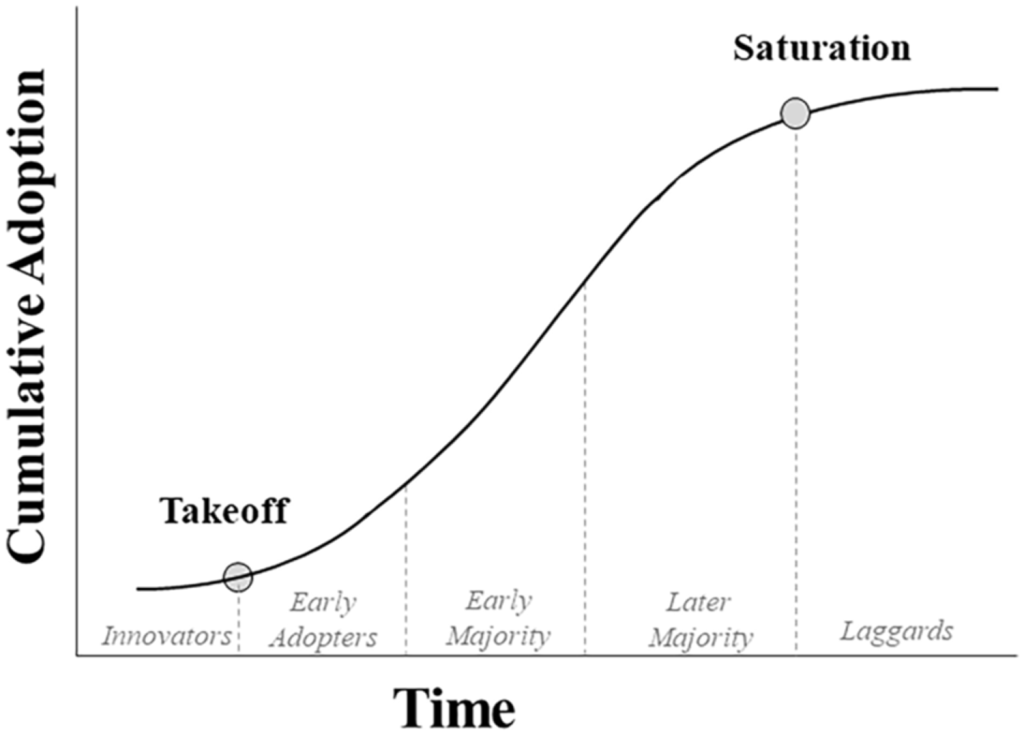
Rogers describes diffusion through a characteristic S-curve. Adoption begins slowly, then accelerates exponentially, before slowing as the market becomes saturated. This temporal dynamic results from the heterogeneity of adoption behaviors within the population.
Rogers identifies five adopter profiles with distinct characteristics:
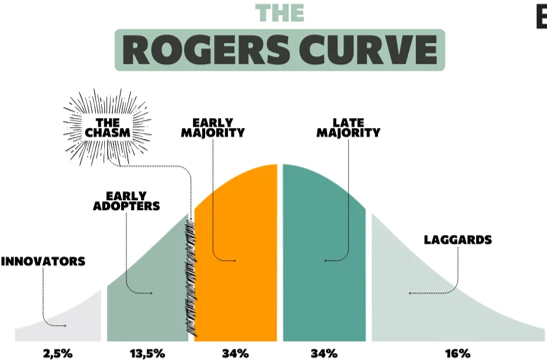
Innovators (approximately 2.5% of the population) are technophile adventurers who willingly assume the risk of adopting unproven technologies. Early adopters (13.5%) constitute opinion leaders whose adoption confers credibility and legitimacy upon the innovation. The early majority (34%) waits and observes before deciding; they seek proven solutions to concrete problems. The late majority (34%) adopts out of social or economic necessity rather than enthusiasm. Finally, laggards (16%) resist until the old technology becomes unusable.
The smartphone trajectory illustrates this sequence. In 2007, the iPhone addressed technology enthusiasts. Around 2010, early adopters invented new uses. In 2013, the majority joined. By 2016, even the reluctant equipped themselves. Today, approximately 85% of the population in developed countries owns a smartphone.
The Chasm and Its Strategic Stakes
Between early adopters and the early majority exists a critical gap that Moore (1991) termed the chasm. Many promising innovations perish at this stage. Google Glass enthused technophiles but never crossed the chasm. Why?
Early adopters seek performance and novelty; they tolerate imperfection and instability. The majority, conversely, demands simple solutions to concrete problems. They do not want to experiment but to solve. This discontinuity in expectations explains the failure of technically advanced technologies that are poorly positioned for the mass market.
Social Networks and Diffusion Dynamics
The structure of social networks profoundly influences the speed and extent of diffusion. Granovetter (1973) highlighted the strength of weak ties: distant contacts—occasional colleagues, distant acquaintances—bring new information from different social circles. Strong ties—close friends, family—tend to convey redundant information.
Digital networks amplify these effects. A study on Facebook showed that if 10% of an individual’s contacts adopt an innovation, their own probability of adoption increases significantly. Online peer influence accelerates diffusion.
Gladwell (2000) popularized the concept of the tipping point: the moment when growth becomes explosive and self-sustaining. Many models place this threshold around 16% adoption. Beyond this point, diffusion feeds itself through network effects and social imitation.
Christakis and Fowler (2009) demonstrated that influence propagates up to three degrees of separation: the behaviors of your friends, your friends’ friends, and their friends affect your own choices. This is why some innovations spread like epidemics.
Determinants of Diffusion Speed
Rogers identifies five perceived attributes of innovation that influence diffusion speed:
Relative advantage: potential adopters must perceive the innovation as superior to existing solutions. PayPal accelerated its adoption by offering ten dollars to new users—a direct and immediate advantage.
Compatibility: the innovation must integrate with existing habits, values, and systems. QR codes, invented in 1994, only diffused massively with the generalization of smartphones that made them easy to use.
Complexity: the more difficult the innovation is to understand and use, the slower its diffusion. The iPhone, with its single main button, was remarkably simple. Linux, despite its technical qualities, remained confined to experts due to its complexity.
Trialability: if users can test the innovation before committing, adoption accelerates. Freemium models exploit this principle. Spotify developed by allowing free listening before subscription.
Observability: seeing others use a product stimulates the desire for adoption. Apple’s white earbuds made iPods immediately recognizable, transforming the product into a social signal.
Mediators and Diffusion Actors
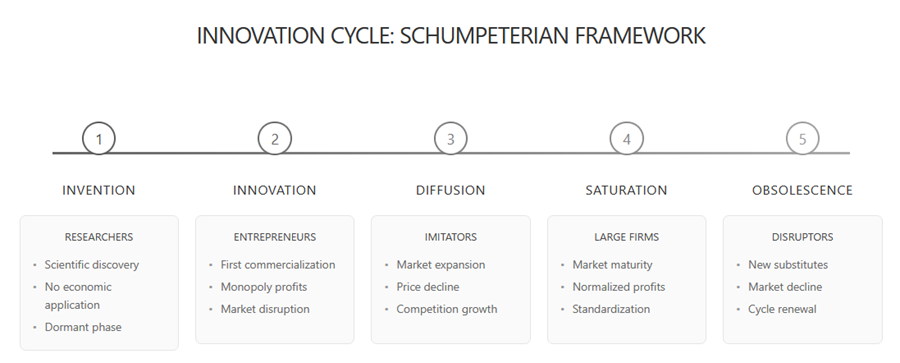
Schumpeter (1934) distinguished invention, innovation, and diffusion. Between these stages, mediators play a crucial role.
Media shape public perception. Favorable coverage accelerates adoption; negative press can halt it abruptly. Prescribers—physicians in healthcare, architects in construction, influencers in consumer goods—guide choices through their recommendations. Individuals often trust these recommendations more than advertising.
Public policies also structure diffusion. Norway massively subsidized electric vehicles, accelerating their adoption; France, with lesser support, experienced slower diffusion. The state is a major diffusion actor.
Technical standards often determine which technologies prevail. VHS beat Betamax. Blu-ray supplanted HD-DVD. Android dominates iOS globally. Frequently, the more open standard diffuses more rapidly
Implications: The Best Technology Does Not Always Win
The analysis of diffusion leads to a counter-intuitive conclusion: the best technology does not necessarily triumph; it is the one that diffuses best that prevails. Innovation is not merely technical; it is fundamentally social. To understand innovation, one must understand diffusion. And success goes to those who master this social spread.