
Advanced Innovation & entrepreneurship
-
Introduction
-
MODULE 1: CAPITAL, VALUE, AND ORGANIZATION
Unit 1 Value Creation, the production results2 Topics|1 Quiz -
Unit 2 What is the capital and how is it build ?2 Topics|1 Quiz
-
Unit 3 : Division and organisation of Labor3 Topics|1 Quiz
-
Unit 4 : Capturing and Retaining Created Value2 Topics|1 Quiz
-
Unit 5 : Value chains and their fragmentation, maximizing the value captured2 Topics|1 Quiz
-
MODULE 2: INNOVATION AS A SOCIAL PROCESSUnit 6 : Adoption, a frontier between invention and innovation2 Topics|1 Quiz
-
Unit 7 : Innovation as a social process2 Topics|1 Quiz
-
Unit 8 : Location and Links in innovation3 Topics|1 Quiz
-
Unit 9 : Innovation process between companies2 Topics|1 Quiz
-
Unit 10 : The case of Knowledge industries3 Topics|1 Quiz
-
Unit 11: Values typologie2 Topics|1 Quiz
-
Unit 12 : Innovation as a process of value proposal3 Topics|1 Quiz
-
MODULE 3: DIGITAL TRANSFORMATION, INTANGIBLE CAPITAL AND RESPONSIBILITYUnit 13 : Digital transformation2 Topics|1 Quiz
-
Unit 14 : Intangible capital role in Innovation4 Topics|1 Quiz
-
Unit 15 : Public investment generating positive externalities in service of innovation3 Topics|1 Quiz
-
Unit 16 : Corporate social and environmental responsibility in an innovation context2 Topics|1 Quiz
-
Unit 17 : Innovative management methods of companies2 Topics|1 Quiz
-
Conclusion and ReferencesGeneral Conclusion
-
Bibliographic references
-
Final Assessment1 Quiz
The Mechanisms of Innovation Appropriation

Alvaro Pina Stranger 04/11/2026
Use the Listen button to hear the transcript. You can pause and resume the audio, and stop it at any time.
Note: You need to mute the video to hear the transcript in other languages instead of English or it will overlap with the video audio.
Please also keep in mind not all languages are supported by the TTS engine.
From Diffusion to Appropriation
SMS was designed to allow telecommunications operators to send technical notifications. Users transformed it into the first mobile messaging system. Twitter was created as a micro-blogging tool; it became a global political arena.
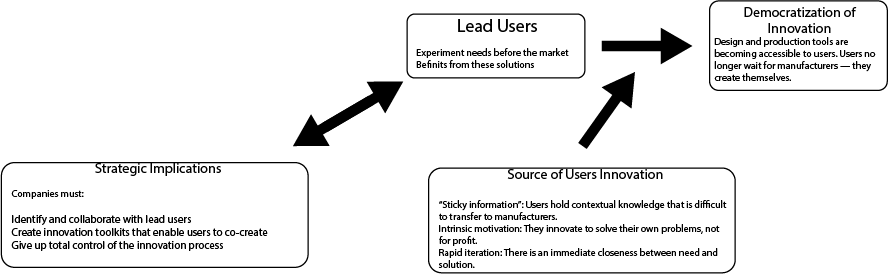
These examples illustrate a fundamental phenomenon: innovation truly exists only when users appropriate it, often by diverting it from its initial use. As Von Hippel (2005) demonstrates in Democratizing Innovation, users are not passive receivers but active actors who transform, adapt, and reinvent technologies.
The Three Phases of Appropriation
Appropriation can be conceptualized as a three-phase process:
Adoption constitutes the first contact with the innovation. The user acquires or accesses the technology.
Adaptation sees the user modify their practices and sometimes the tool itself to integrate it into their specific context.
Routinization marks the moment when the innovation becomes an integral part of daily life, something obvious and normal.
The theory of adaptive appropriation emphasizes that users do not simply follow the “script” anticipated by designers. They “tinker” with technology. Excel, designed for financial calculations, becomes a drawing tool, a database, even a video game. This plasticity—the capacity of a technology to support unforeseen uses—largely contributes to determining its success.
Script and Description: The Rewriting of Uses
Akrich (1992) developed the concepts of script and description to analyze relations between technical objects and users. The script designates the behaviors and uses inscribed in the object by its designers. The description designates the actual uses created by users.
The French Minitel illustrates this gap. It was designed (scripted) for information consultation—telephone directory, administrative services. Users transformed it into a dating tool with erotic messaging services. Appropriation rewrites the initial script.
Conditions for Appropriation
Proulx (2005) identifies four conditions necessary for appropriation:
Technical mastery: the user must acquire the minimum skills to use the innovation.
Integration into practices: the innovation must find its place in daily routines.
Possibility of creation: the user must be able to personalize, adapt, or even divert the tool.
Shared collective representation: a common sense of the innovation must emerge within the social group.
Without these four dimensions, the innovation remains foreign; it is not truly appropriated.
Barriers to Appropriation
Rogers (2003) identifies several obstacles to appropriation: cultural incompatibility, excessive complexity, absence of perceived benefit.
Google Glass failed because social appropriation was impossible. Wearing a camera on one’s face transgressed social codes of privacy and interaction. (However, the recent collaboration between Meta and Ray-Ban seems to revive the ambition of connected glasses.)
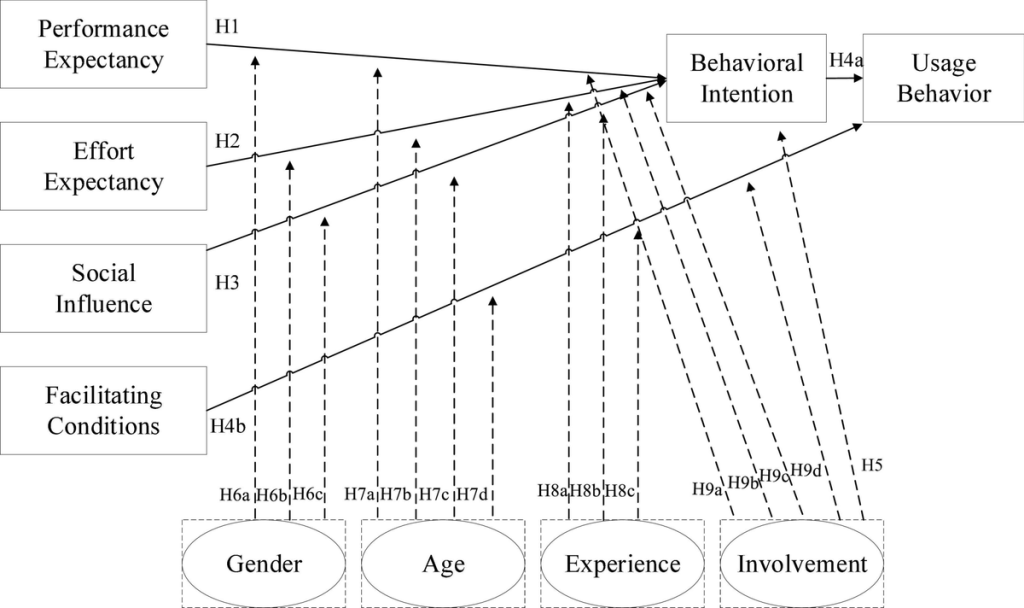
The UTAUT model (Venkatesh et al., 2003) identifies four key factors in technological adoption: perceived utility, ease of use, social influence, and facilitating conditions. Appropriation is as much social as it is technical.
Non-Users and Misuses
Non-users are not passive. They resist, refuse, abandon. According to Crédoc (2023), approximately 20% of French people voluntarily choose not to own a smartphone. This non-appropriation is a choice, not an inability.
One also observes misuses: uses contrary to prescriptions but that make sense for the user. Some elderly people use tablets as digital photo frames. This is a form of appropriation, even if it disappoints designers.
Organizational Appropriation and Conflicts
Appropriation extends beyond the individual level. Alter (2000) shows that in organizations, appropriation is often a conflictual process. Innovations disturb established powers, routines, professional identities.
The case of ERP (Enterprise Resource Planning) systems is emblematic. These integrated management software packages are generally imposed by management. They fail in approximately 60% of cases due to lack of appropriation by users, who suffer them more than they adopt them. Successes always involve co-construction with users.
In non-totalitarian environments, appropriation requires a cultural change that technology alone cannot impose.
Communities of Practice and Collective Appropriation
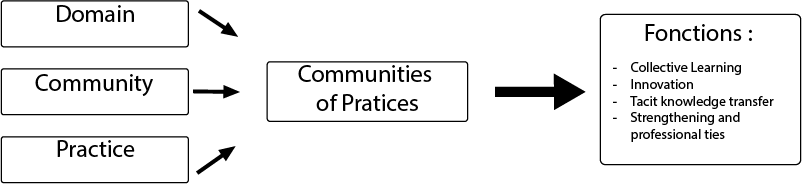
The communities of practice theorized by Wenger (1998) become crucial for appropriation. This occurs collectively, through mutual learning, sharing of tips, construction of common norms.
Slack or Discord succeed where others fail because they enable this community appropriation. Generative artificial intelligence poses new appropriation challenges. ChatGPT has 180 million users, but how many have truly appropriated it beyond very basic use? Studies suggest that only approximately 10% truly exploit its potential.
Implications for the Innovator
Innovation is never complete when it leaves the laboratory. It is constructed through the appropriation of users who transform it, adapt it, sometimes divert it. This appropriation is not a final stage but a continuous process of co-construction.
Innovations that succeed are not necessarily the most technically sophisticated. They are those that allow creative appropriation. The challenge for the innovator is no longer to impose a use but to create the conditions for appropriation.