
Advanced Innovation & entrepreneurship
-
Introduction
-
MODULE 1: CAPITAL, VALUE, AND ORGANIZATION
Unit 1 Value Creation, the production results2 Topics|1 Quiz -
Unit 2 What is the capital and how is it build ?2 Topics|1 Quiz
-
Unit 3 : Division and organisation of Labor3 Topics|1 Quiz
-
Unit 4 : Capturing and Retaining Created Value2 Topics|1 Quiz
-
Unit 5 : Value chains and their fragmentation, maximizing the value captured2 Topics|1 Quiz
-
MODULE 2: INNOVATION AS A SOCIAL PROCESSUnit 6 : Adoption, a frontier between invention and innovation2 Topics|1 Quiz
-
Unit 7 : Innovation as a social process2 Topics|1 Quiz
-
Unit 8 : Location and Links in innovation3 Topics|1 Quiz
-
Unit 9 : Innovation process between companies2 Topics|1 Quiz
-
Unit 10 : The case of Knowledge industries3 Topics|1 Quiz
-
Unit 11: Values typologie2 Topics|1 Quiz
-
Unit 12 : Innovation as a process of value proposal3 Topics|1 Quiz
-
MODULE 3: DIGITAL TRANSFORMATION, INTANGIBLE CAPITAL AND RESPONSIBILITYUnit 13 : Digital transformation2 Topics|1 Quiz
-
Unit 14 : Intangible capital role in Innovation4 Topics|1 Quiz
-
Unit 15 : Public investment generating positive externalities in service of innovation3 Topics|1 Quiz
-
Unit 16 : Corporate social and environmental responsibility in an innovation context2 Topics|1 Quiz
-
Unit 17 : Innovative management methods of companies2 Topics|1 Quiz
-
Conclusion and ReferencesGeneral Conclusion
-
Bibliographic references
-
Final Assessment1 Quiz

Use the Listen button to hear the transcript. You can pause and resume the audio, and stop it at any time.
Note: You need to mute the video to hear the transcript in other languages instead of English or it will overlap with the video audio.
Please also keep in mind not all languages are supported by the TTS engine.
Shouldice Hospital: An Emblematic Example
Surgeons at Shouldice Hospital, near Toronto, perform over seven thousand hernia operations per year with a recurrence rate near zero. Their secret is not technological. It is a community of practice—a place where gestures are discussed, refined, and transmitted.
These communities illustrate a key point: innovation comes from shared experience.
Definition and Constitutive Elements
A community of practice is a group of people who share a concern or passion. They interact regularly and learn to do better together.
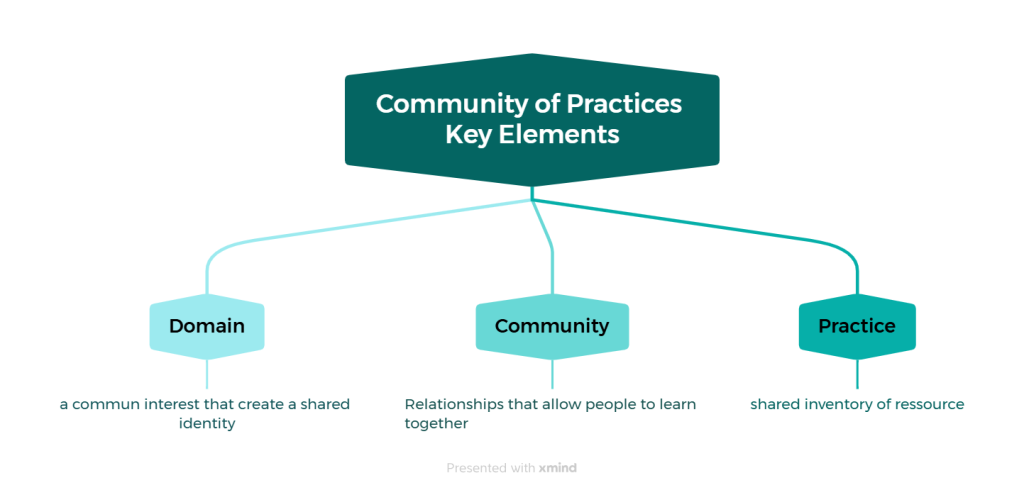
Lave and Wenger (1991), in Situated Learning, define three constitutive elements:
The domain: a shared interest that builds identity. Sommeliers share wine; data scientists share data.
The community: relationships that support learning. More than a network—there is real engagement.
The practice: shared resources—experiences, tools, ways of doing. Cremona luthiers share techniques transmitted for centuries.
Ubiquity of Communities of Practice
These communities are everywhere: nurses discussing difficult cases during lunch, developers meeting at meetups, farmers testing agroecology. Here, innovation starts from action. This is situated learning.
Consider fab labs. These digital workshops where makers share machines and know-how. In Barcelona, a fab lab brings together architects and biologists. Together, they create living bricks that purify air. This idea was not planned. It emerged from practice.
Legitimate Peripheral Participation
Learning in these communities follows a particular path that Lave and Wenger call legitimate peripheral participation.
Beginners start at the margin. They observe. Then they participate, increasingly. A young baker begins simply shaping dough. Then kneading. Then creating recipes. Step by step, skills grow. But also culture, values, identity.
This is knowledge in action—knowing by doing. Like sensing if dough is ready by sight and touch, not by a timer.
Innovation Mechanisms in Communities of Practice
Innovation follows several paths:
Reification: practice becomes tools, procedures, concepts. Emergency teams create triage rules. Tacit knowledge becomes explicit.
Collective bricolage: the group faces a problem and improvises with what it has. Rally mechanics innovate; later, automakers adopt these ideas.
Cross-pollination: when communities meet, innovation accelerates. Design thinking appears when designers meet managers. Bioinformatics appears when biology meets computing.
Toyota formalizes this logic with quality circles and kaizen. Workers improve processes every day. Thousands of small ideas together transform production.
Spaces and Communities
Communities need space. And space shapes innovation.
Dedicated spaces: hackerspaces, workshops, culinary labs. Layout matters—movable tables, writable walls, quiet corners invite exchange.
Diverted spaces: official spaces used informally. The coffee machine. At Bell Labs, long corridors forced meetings. Chance became design.
Hybrid spaces: physical and digital. Forums before, Discord today. Thousands connect by interest, collaborate, and innovate at scale.
Limits of All-Virtual
Despite digital growth, limits appear. Brown and Duguid (2001) show this clearly. The pandemic confirmed it: all-virtual is not enough. Communities need presence, physical moments, to build trust. And trust enables innovation.