Advanced Innovation & entrepreneurship
-
Introduction
-
MODULE 1: CAPITAL, VALUE, AND ORGANIZATION
Unit 1 Value Creation, the production results2 Topics|1 Quiz -
Unit 2 What is the capital and how is it build ?2 Topics|1 Quiz
-
Unit 3 : Division and organisation of Labor3 Topics|1 Quiz
-
Unit 4 : Capturing and Retaining Created Value2 Topics|1 Quiz
-
Unit 5 : Value chains and their fragmentation, maximizing the value captured2 Topics|1 Quiz
-
MODULE 2: INNOVATION AS A SOCIAL PROCESSUnit 6 : Adoption, a frontier between invention and innovation2 Topics|1 Quiz
-
Unit 7 : Innovation as a social process2 Topics|1 Quiz
-
Unit 8 : Location and Links in innovation3 Topics|1 Quiz
-
Unit 9 : Innovation process between companies2 Topics|1 Quiz
-
Unit 10 : The case of Knowledge industries3 Topics|1 Quiz
-
Unit 11: Values typologie2 Topics|1 Quiz
-
Unit 12 : Innovation as a process of value proposal3 Topics|1 Quiz
-
MODULE 3: DIGITAL TRANSFORMATION, INTANGIBLE CAPITAL AND RESPONSIBILITYUnit 13 : Digital transformation2 Topics|1 Quiz
-
Unit 14 : Intangible capital role in Innovation4 Topics|1 Quiz
-
Unit 15 : Public investment generating positive externalities in service of innovation3 Topics|1 Quiz
-
Unit 16 : Corporate social and environmental responsibility in an innovation context2 Topics|1 Quiz
-
Unit 17 : Innovative management methods of companies2 Topics|1 Quiz
-
Conclusion and ReferencesGeneral Conclusion
-
Bibliographic references
-
Final Assessment1 Quiz

Use the Listen button to hear the transcript. You can pause and resume the audio, and stop it at any time.
Note: You need to mute the video to hear the transcript in other languages instead of English or it will overlap with the video audio.
Please also keep in mind not all languages are supported by the TTS engine.
Beyond Financial Profit
When a company says it creates value, is it speaking only of profit? In the first module, we were essentially interested in production—the mechanism of value creation—but without developing what value itself is.
Consider a fashion company that generates significant revenue but also chooses to use sustainable materials and support local initiatives. Can we say this company creates more value than another focused only on maximizing profit?
Definition and Multidimensionality of Value
Value can be defined as what is judged desirable, useful, or important in a given context. In economics, this notion extends far beyond the simple financial aspect.
Mazzucato (2018), in The Value of Everything, insists that not all economic activities necessarily create real value. Some merely redistribute or extract it, like certain financial or speculative operations.
Thus, when we speak of value creation, we must always ask: for whom, and what is the nature of this value?
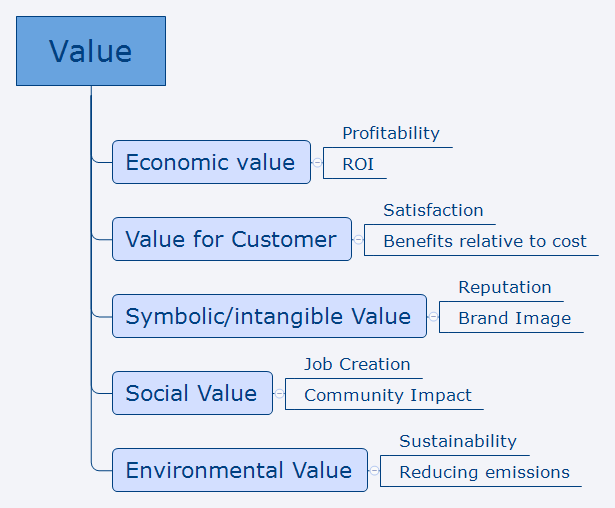
Different Forms of Value
Economic or financial value: profit, profitability, return on investment. A company that optimizes its margins creates financial value for shareholders.
Customer value: the satisfaction a product or service brings relative to the cost it represents. “Perceived benefits” minus incurred costs.
Social value: the impact of economic activities on society. A company can create value by promoting professional integration, supporting local associations, or contributing to social cohesion.
Environmental value: contribution to nature preservation—reduction of CO₂ emissions, biodiversity protection, use of renewable resources.
Symbolic or intangible value: reputation, brand image, the trust that customers or partners grant the company. Some brands, like Patagonia or Tesla, possess an “aura” that attracts or repels customers and investors, even if their products are not the cheapest on the market.
Creating value thus goes far beyond simple financial profit. A company can create economic, social, environmental, and symbolic value.