
Advanced Innovation & entrepreneurship
-
Introduction
-
MODULE 1: CAPITAL, VALUE, AND ORGANIZATION
Unit 1 Value Creation, the production results2 Topics|1 Quiz -
Unit 2 What is the capital and how is it build ?2 Topics|1 Quiz
-
Unit 3 : Division and organisation of Labor3 Topics|1 Quiz
-
Unit 4 : Capturing and Retaining Created Value2 Topics|1 Quiz
-
Unit 5 : Value chains and their fragmentation, maximizing the value captured2 Topics|1 Quiz
-
MODULE 2: INNOVATION AS A SOCIAL PROCESSUnit 6 : Adoption, a frontier between invention and innovation2 Topics|1 Quiz
-
Unit 7 : Innovation as a social process2 Topics|1 Quiz
-
Unit 8 : Location and Links in innovation3 Topics|1 Quiz
-
Unit 9 : Innovation process between companies2 Topics|1 Quiz
-
Unit 10 : The case of Knowledge industries3 Topics|1 Quiz
-
Unit 11: Values typologie2 Topics|1 Quiz
-
Unit 12 : Innovation as a process of value proposal3 Topics|1 Quiz
-
MODULE 3: DIGITAL TRANSFORMATION, INTANGIBLE CAPITAL AND RESPONSIBILITYUnit 13 : Digital transformation2 Topics|1 Quiz
-
Unit 14 : Intangible capital role in Innovation4 Topics|1 Quiz
-
Unit 15 : Public investment generating positive externalities in service of innovation3 Topics|1 Quiz
-
Unit 16 : Corporate social and environmental responsibility in an innovation context2 Topics|1 Quiz
-
Unit 17 : Innovative management methods of companies2 Topics|1 Quiz
-
Conclusion and ReferencesGeneral Conclusion
-
Bibliographic references
-
Final Assessment1 Quiz

Use the Listen button to hear the transcript. You can pause and resume the audio, and stop it at any time.
Note: You need to mute the video to hear the transcript in other languages instead of English or it will overlap with the video audio.
Please also keep in mind not all languages are supported by the TTS engine.
From Research to Market
GPS was first built for the U.S. military. Velcro came from studying burdock plants in nature. Touch screens were used in industry and defense long before smartphones. All come from technology transfer.
Technology transfer designates the path by which a technology or knowledge created in research—often in universities or public laboratories—moves to companies to be transformed into products, services, and market value.
This is not simply “selling” a discovery. It is a long process. One must transform a laboratory result into something that works in the real world. A proof of concept is not a product. That step is the difficult part.
Importance of Technology Transfer
Technology transfer matters because public research is costly—billions of euros. Laboratories produce many ideas and inventions. Technology transfer helps society benefit from that investment. It transforms knowledge into real economic and social value.
Bozeman (2000), a major scholar on this topic, states it clearly: technology transfer is now a central pillar of innovation in modern economies.
Actors and Modalities of Transfer
The main actors are first universities and public research laboratories that create knowledge, then companies that can develop, produce, and sell.
Between them are intermediaries. In France, SATTs (Sociétés d’Accélération du Transfert de Technologies). In other countries, Technology Transfer Offices (TTOs). Their job is to help researchers bring their work to market.
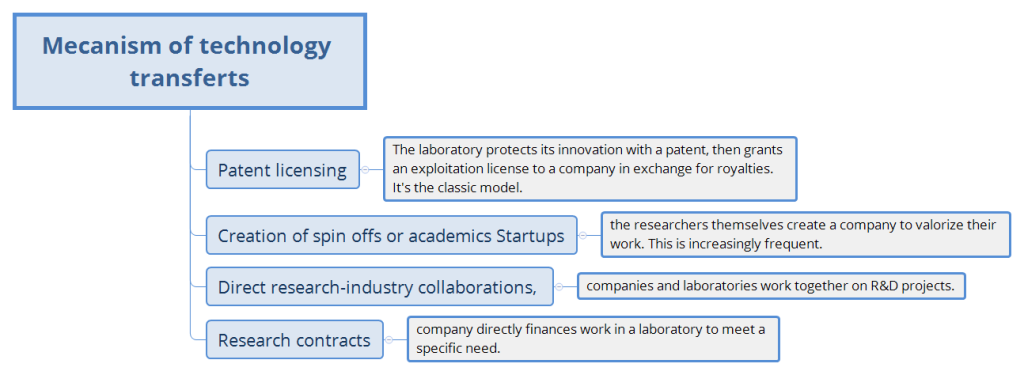
Transfer occurs through several routes:
Patent licensing: the laboratory patents the invention, then a company buys a license to use it. The laboratory receives royalties. This is the classic model.
Spin-offs or academic startups: researchers create a company to develop and sell the invention. This is growing rapidly.
Joint research projects: laboratories and companies work together on R&D.
Research contracts: a company pays a laboratory to solve a specific problem.
The Valley of Death
But there is a major obstacle called the “valley of death.” It sits between two moments: when the prototype works in the laboratory and when a real product succeeds on the market. Many inventions die there because funding is missing, business skills are missing, or market need is not proven.
The BioNTech and mRNA Example
A strong example is BioNTech and messenger RNA. mRNA technology was developed over decades in public laboratories. Katalin Karikó and Drew Weissman worked on it at the University of Pennsylvania since the 1990s. It seemed promising but there was no clear solution for decades.
In 2008, BioNTech was created in Germany to bring this research to market. The company partnered with academia, invested heavily in development. Then COVID-19 arrived.
In less than a year, this academic research became a vaccine. BioNTech and Pfizer managed the transfer successfully. The result was a highly effective vaccine used worldwide. A clear case where deep research transformed into major innovation with huge impact on society.
Technology transfer is the bridge between science and society, between the laboratory and the market.