
Advanced Innovation & entrepreneurship
-
Introduction
-
MODULE 1: CAPITAL, VALUE, AND ORGANIZATION
Unit 1 Value Creation, the production results2 Topics|1 Quiz -
Unit 2 What is the capital and how is it build ?2 Topics|1 Quiz
-
Unit 3 : Division and organisation of Labor3 Topics|1 Quiz
-
Unit 4 : Capturing and Retaining Created Value2 Topics|1 Quiz
-
Unit 5 : Value chains and their fragmentation, maximizing the value captured2 Topics|1 Quiz
-
MODULE 2: INNOVATION AS A SOCIAL PROCESSUnit 6 : Adoption, a frontier between invention and innovation2 Topics|1 Quiz
-
Unit 7 : Innovation as a social process2 Topics|1 Quiz
-
Unit 8 : Location and Links in innovation3 Topics|1 Quiz
-
Unit 9 : Innovation process between companies2 Topics|1 Quiz
-
Unit 10 : The case of Knowledge industries3 Topics|1 Quiz
-
Unit 11: Values typologie2 Topics|1 Quiz
-
Unit 12 : Innovation as a process of value proposal3 Topics|1 Quiz
-
MODULE 3: DIGITAL TRANSFORMATION, INTANGIBLE CAPITAL AND RESPONSIBILITYUnit 13 : Digital transformation2 Topics|1 Quiz
-
Unit 14 : Intangible capital role in Innovation4 Topics|1 Quiz
-
Unit 15 : Public investment generating positive externalities in service of innovation3 Topics|1 Quiz
-
Unit 16 : Corporate social and environmental responsibility in an innovation context2 Topics|1 Quiz
-
Unit 17 : Innovative management methods of companies2 Topics|1 Quiz
-
Conclusion and ReferencesGeneral Conclusion
-
Bibliographic references
-
Final Assessment1 Quiz

Use the Listen button to hear the transcript. You can pause and resume the audio, and stop it at any time.
Note: You need to mute the video to hear the transcript in other languages instead of English or it will overlap with the video audio.
Please also keep in mind not all languages are supported by the TTS engine.
Technology and Value: A Non-Linear Relationship
High technology is not always necessary to create real value. Consider the Segway—a revolutionary gyropod supposed to transform urban mobility. Yet it failed on the market. Now consider the Post-it—a simple paper with weak glue. And it became essential worldwide.
The Segway had great technology but a vague value proposition. The Post-it solved a simple problem: marking documents without damaging them. One does not need cutting-edge technology to create strong value.
The Value Proposition
A value proposition is the promise of value that a product or service makes to customers. In other words: why should a customer choose your solution rather than another, or rather than doing nothing?
And this is key: the biggest competitor is often not another company. It is the status quo. It is inertia. It is continuing as before.
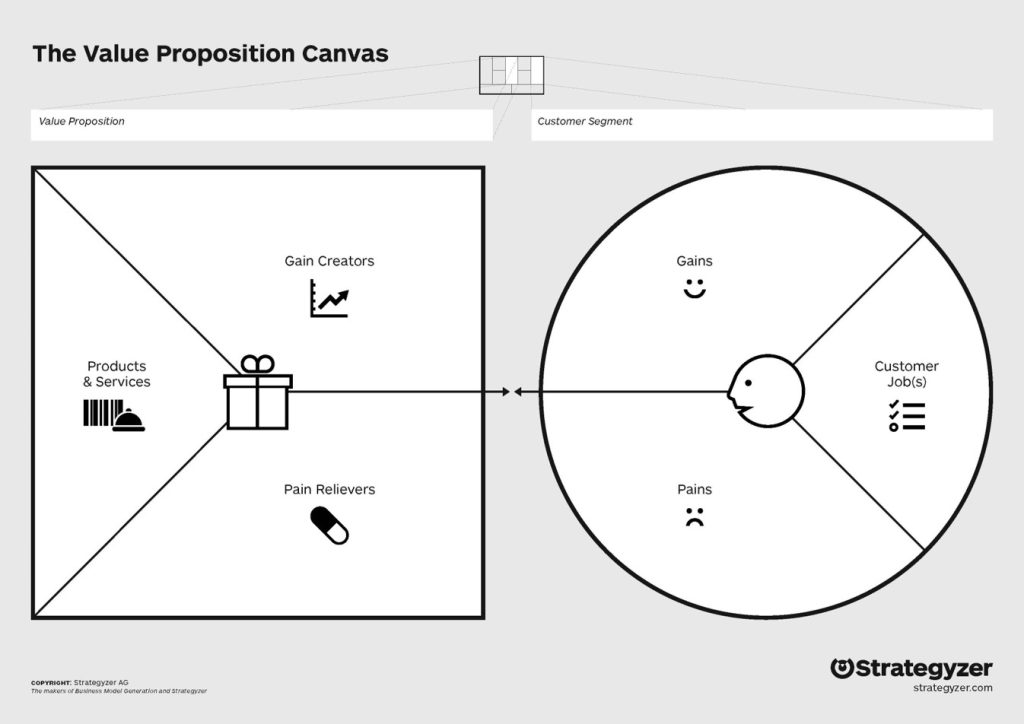
Osterwalder’s Value Proposition Canvas
Osterwalder offers a useful tool: the Value Proposition Canvas. Imagine two circles facing each other.
On the left, the customer profile with three parts: the tasks the customer wants to accomplish, the problems they want to solve, the needs they want to satisfy; their frustrations—obstacles, fears, and risks; their desired gains—what would make life easier, simpler, or better.
On the right, your offer: how you reduce frustrations; how you create gains; the list of your products and services.
The magic is the fit. If what the customer wants matches what you offer. No fit means no perceived value. And without perceived value, there is no business.
Dimensions of Value
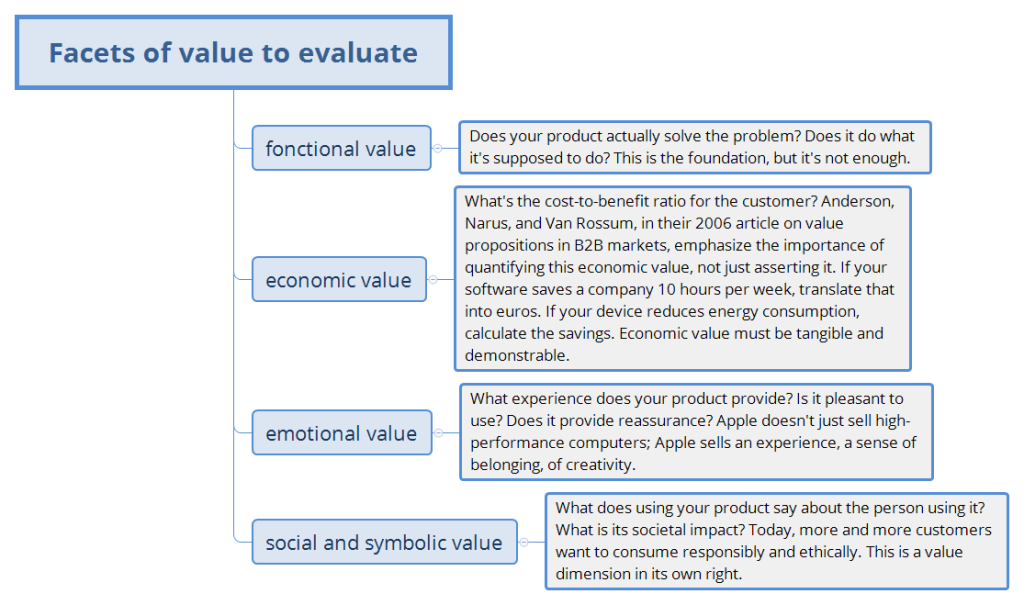
Value has several dimensions that must be verified:
Functional value: does the product really solve the problem? Does it do what it promises? This is the base but it is not sufficient.
Economic value: what is the cost-benefit for the customer? This must be measurable. If your software saves ten hours per week, convert that time into euros.
Emotional value: what experience do you offer? Is it pleasant, simple, reassuring? Apple does not only sell computers; it sells an experience and a sense of belonging.
Social or symbolic value: what does using your product say about the user? Many customers want ethical and responsible products. This creates value too.
Methods for Testing the Value Proposition
How to test if your value proposition works?
Talk to customers: do real interviews. Ask open questions.
Prototype quickly and test early: do not spend years building something no one wants. Dropbox did this with a short demo video. Before any real product existed, the video attracted huge interest and validated the need.
Compare with competitors and alternatives: if you build project management software, your competitor is also Excel and a wall full of Post-its. The question is: what do you bring that is worth changing habits for?
Use metrics: Net Promoter Score, conversion rate, retention rate, Customer Lifetime Value. Numbers reveal the truth.
Value is not what you create. Value is what the customer perceives. And evaluating value is not a one-time task. It is continuous. Needs evolve. Competition shifts. Context changes.