Advanced Innovation & entrepreneurship
-
Introduction
-
MODULE 1: CAPITAL, VALUE, AND ORGANIZATION
Unit 1 Value Creation, the production results2 Topics|1 Quiz -
Unit 2 What is the capital and how is it build ?2 Topics|1 Quiz
-
Unit 3 : Division and organisation of Labor3 Topics|1 Quiz
-
Unit 4 : Capturing and Retaining Created Value2 Topics|1 Quiz
-
Unit 5 : Value chains and their fragmentation, maximizing the value captured2 Topics|1 Quiz
-
MODULE 2: INNOVATION AS A SOCIAL PROCESSUnit 6 : Adoption, a frontier between invention and innovation2 Topics|1 Quiz
-
Unit 7 : Innovation as a social process2 Topics|1 Quiz
-
Unit 8 : Location and Links in innovation3 Topics|1 Quiz
-
Unit 9 : Innovation process between companies2 Topics|1 Quiz
-
Unit 10 : The case of Knowledge industries3 Topics|1 Quiz
-
Unit 11: Values typologie2 Topics|1 Quiz
-
Unit 12 : Innovation as a process of value proposal3 Topics|1 Quiz
-
MODULE 3: DIGITAL TRANSFORMATION, INTANGIBLE CAPITAL AND RESPONSIBILITYUnit 13 : Digital transformation2 Topics|1 Quiz
-
Unit 14 : Intangible capital role in Innovation4 Topics|1 Quiz
-
Unit 15 : Public investment generating positive externalities in service of innovation3 Topics|1 Quiz
-
Unit 16 : Corporate social and environmental responsibility in an innovation context2 Topics|1 Quiz
-
Unit 17 : Innovative management methods of companies2 Topics|1 Quiz
-
Conclusion and ReferencesGeneral Conclusion
-
Bibliographic references
-
Final Assessment1 Quiz

Use the Listen button to hear the transcript. You can pause and resume the audio, and stop it at any time.
Note: You need to mute the video to hear the transcript in other languages instead of English or it will overlap with the video audio.
Please also keep in mind not all languages are supported by the TTS engine.
Definition and Examples
Let us explore a key economic idea: externalities. It is simple, and it explains why the State plays a major role in innovation.
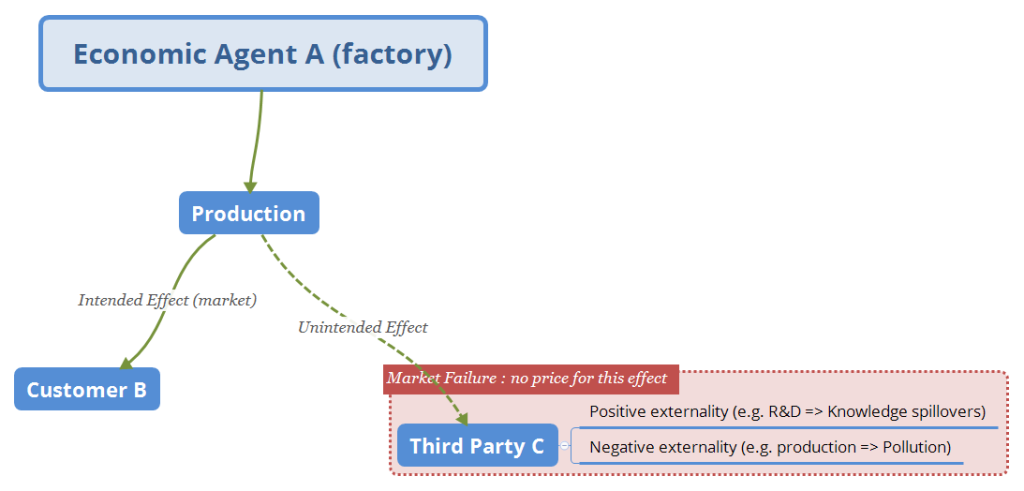
Imagine you live next to a bakery. Every morning, the smell of fresh bread wakes you up. You enjoy it without paying. This smell is a positive externality.
An externality is a side effect of an activity. It affects people who are not directly involved. And this effect does not appear in market prices. It can be positive, like the bakery, or negative, like factory pollution.
The key point is this: the market does not account for these effects. The bakery does not charge for the smell. And factories used to pollute for free. This is called a market failure.
Positive Externalities and Innovation
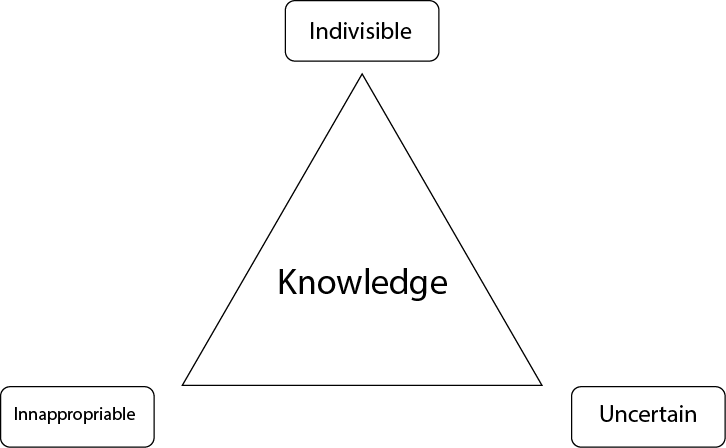
Positive externalities matter a lot for innovation. Kenneth Arrow, Nobel Prize winner in 1962, explained why. Knowledge has three characteristics: it is indivisible, it is difficult to appropriate, and it is uncertain.
Take fundamental research. When a laboratory discovers a new principle, all of society benefits. Other laboratories use it. Companies build new technologies on top. But the first laboratory captures only a tiny fraction of the value.
This is the innovation paradox. The more fundamental a discovery, the less economic value the creator captures. The laser is a perfect example. It transformed medicine, industry, and telecommunications. But the inventors captured almost none of the value created.
Another example is the Internet. It was first developed by American public agencies. Today it generates trillions in value. The spillovers are massive, far greater than the initial investment.
Consequences for Public Intervention
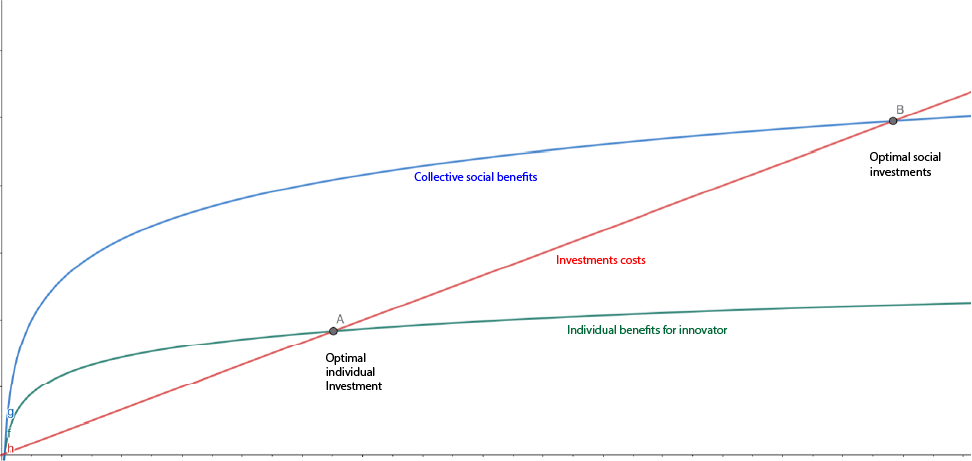
When positive externalities exist, the market produces less innovation than is good for society.
Take education. Training an engineer is expensive. A company that trains someone can lose them to a competitor. So companies underinvest. This is why the State finances public education. Social benefits are far greater than what any single company can capture.
The State intervenes to correct the problem. It finances research, builds infrastructure, creates public research institutions. Without this intervention, we would have much less innovation.
This idea is not just theoretical. Joseph Stiglitz, another Nobel Prize winner, showed that knowledge is the ultimate public good and that markets underinvest in it.
This justifies public spending. It explains why GPS, the Internet, touch screens, and biotechnologies all required massive public investment at the start. The private sector alone would never have taken such large and uncertain risks.
Understanding externalities is essential. It shows that innovation is not only a story of startups in garages. It is the result of an entire ecosystem where public investment plays a crucial role.