
Advanced Innovation & entrepreneurship
-
Introduction
-
MODULE 1: CAPITAL, VALUE, AND ORGANIZATION
Unit 1 Value Creation, the production results2 Topics|1 Quiz -
Unit 2 What is the capital and how is it build ?2 Topics|1 Quiz
-
Unit 3 : Division and organisation of Labor3 Topics|1 Quiz
-
Unit 4 : Capturing and Retaining Created Value2 Topics|1 Quiz
-
Unit 5 : Value chains and their fragmentation, maximizing the value captured2 Topics|1 Quiz
-
MODULE 2: INNOVATION AS A SOCIAL PROCESSUnit 6 : Adoption, a frontier between invention and innovation2 Topics|1 Quiz
-
Unit 7 : Innovation as a social process2 Topics|1 Quiz
-
Unit 8 : Location and Links in innovation3 Topics|1 Quiz
-
Unit 9 : Innovation process between companies2 Topics|1 Quiz
-
Unit 10 : The case of Knowledge industries3 Topics|1 Quiz
-
Unit 11: Values typologie2 Topics|1 Quiz
-
Unit 12 : Innovation as a process of value proposal3 Topics|1 Quiz
-
MODULE 3: DIGITAL TRANSFORMATION, INTANGIBLE CAPITAL AND RESPONSIBILITYUnit 13 : Digital transformation2 Topics|1 Quiz
-
Unit 14 : Intangible capital role in Innovation4 Topics|1 Quiz
-
Unit 15 : Public investment generating positive externalities in service of innovation3 Topics|1 Quiz
-
Unit 16 : Corporate social and environmental responsibility in an innovation context2 Topics|1 Quiz
-
Unit 17 : Innovative management methods of companies2 Topics|1 Quiz
-
Conclusion and ReferencesGeneral Conclusion
-
Bibliographic references
-
Final Assessment1 Quiz
Corporate Social and Environmental Responsibility (CSR)

Alvaro Pina Stranger 04/11/2026
Use the Listen button to hear the transcript. You can pause and resume the audio, and stop it at any time.
Note: You need to mute the video to hear the transcript in other languages instead of English or it will overlap with the video audio.
Please also keep in mind not all languages are supported by the TTS engine.
Dieselgate: An Illustration of Tensions
In 2015, Volkswagen, a symbol of German engineering and a company valued at tens of billions of euros, was caught in flagrant massive fraud. “Dieselgate” revealed that the manufacturer had deliberately modified the software of 11 million cars to circumvent anti-pollution standards. For years, Volkswagen communicated about its environmental commitment while poisoning the air of millions of people.
This scandal illustrates a fundamental tension: to what extent are innovative companies responsible for the social and environmental consequences of their innovations? Can we let innovation unfold freely hoping that “the invisible hand of the market” will regulate bad behavior? Or must we regulate, constrain, and hold accountable?
The answer to these questions defines what is called Corporate Social and Environmental Responsibility (CSR)—a concept that was marginal thirty years ago and has become central to the debate on innovation.
Historical Evolution of the Concept
CSR is not a recent invention. It can be traced back to the late nineteenth century, when some philanthropist industrialists improved the conditions of their workers and invested in education and public health.
But it was in the 1950s that the concept was formalized. Howard Bowen, in his work Social Responsibilities of the Businessman, posed the question: do business leaders have obligations that go beyond profit maximization?
For decades, the dominant answer was that of Milton Friedman in 1970: “The social responsibility of business is to increase its profits.” According to this view, the company fulfills its social role by creating wealth, paying taxes, and employing people. The rest—environment, social justice, ethics—falls under the responsibility of the State and regulation.
This view was progressively challenged. In the 1980s and 1990s emerged the concept of stakeholders, developed by Edward Freeman. The company has a responsibility not only to shareholders but to all those affected by its activities: employees, customers, suppliers, local communities, the environment, and future generations.
Dimensions of CSR for Innovative Companies
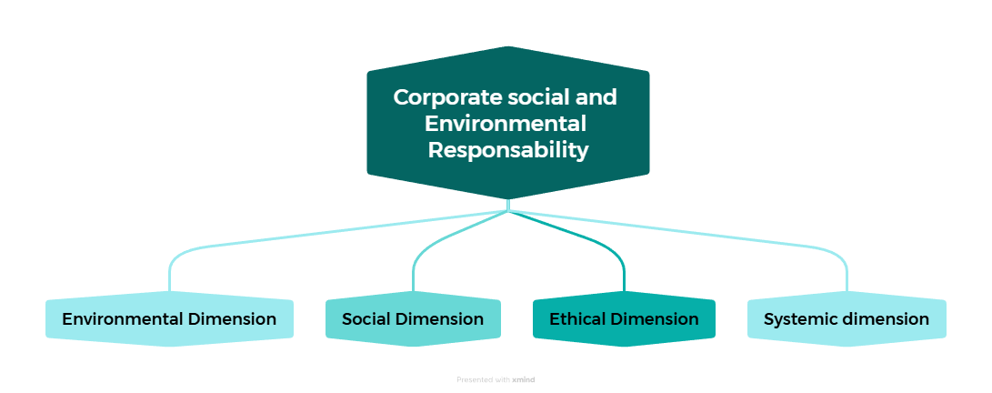
Concretely, what does CSR mean for innovative companies? Several dimensions can be distinguished.
The environmental dimension is the most visible. It requires companies to measure and reduce their ecological footprint: CO₂ emissions, water and energy consumption, waste production, biodiversity preservation. In the context of innovation, this means integrating these criteria from the design phase of products—what is called eco-design. Patagonia, the outdoor clothing company, is an example: it repairs products rather than encouraging new purchases, uses recycled materials, and gives 1% of its revenue to environmental causes.
The social dimension concerns working conditions, diversity, equity, and impact on communities. For innovative companies, this is particularly critical. The Foxconn factories that manufacture iPhones have been accused of working conditions close to slavery. Amazon’s recruitment algorithms reproduced sexist biases. Technological innovation must not come at the cost of human exploitation or discrimination.
The ethical dimension touches on questions of transparency, integrity, and respect for privacy. The GAFAMs collect phenomenal quantities of personal data. How are they used? Who has access? What guarantees for users? The Cambridge Analytica scandal showed that Facebook had allowed the diversion of data from 87 million users for political manipulation purposes. CSR requires responsible data governance.
The systemic dimension is perhaps the most ambitious. It is not content to reduce negative impacts; it aims to create shared value—a concept developed by Michael Porter and Mark Kramer (2011). The idea is that the company can innovate in ways that solve a societal problem while creating economic value. Grameen Bank created microcredit to lift millions of people out of poverty while building an economically viable model.
The Problem of Greenwashing
However, CSR poses a major problem: how to distinguish genuine commitment from mere marketing discourse?
The term “greenwashing” designates this practice of communicating massively about marginal environmental actions to mask fundamentally unsustainable practices. An oil company that funds a few wind turbines while investing hundreds of billions in new fossil deposits is greenwashing.
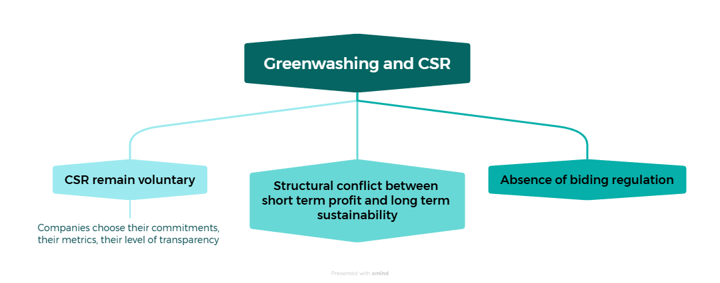
Several factors explain this hypocrisy. First, CSR remains largely voluntary. Companies choose their commitments, their metrics, their level of transparency. They communicate about what suits them and pass over in silence what embarrasses them. CSR reports are often communication tools rather than transparency exercises.
Second, there is a structural conflict between the logic of short-term profit maximization and long-term sustainability objectives. A manager evaluated on short-term results will have difficulty justifying CSR investments that are not visible on immediate profitability.
Third, the absence of binding regulation allows some companies to “free-ride”—benefit from the efforts of others without making their own. If a company invests massively in sustainability while its competitors do not, it will be competitively disadvantaged.
Toward Binding Regulatory Frameworks
This is why we observe an evolution toward more binding regulatory frameworks. The European Union has introduced the Corporate Sustainability Reporting Directive, which requires large companies to publish detailed reports on their social and environmental impacts. The European green taxonomy defines what can be considered a “sustainable investment.” These regulations aim to transform CSR from voluntary commitment into legal obligation.
Assessment and Perspectives
CSR represents an attempt to reconcile economic innovation with social and environmental responsibility. It recognizes that companies, as powerful actors in the transformation of the world, have a responsibility that goes beyond mere compliance with the law.
But CSR remains an ambiguous and criticized concept. For some, it is a tool for transformation toward more responsible and sustainable capitalism. For others, it is a screen that allows companies to preserve their legitimacy without fundamentally questioning their models.
The reality is probably somewhere in between. CSR has enabled real progress: companies that reduce their emissions, improve their working conditions, innovate more inclusively. But it has not prevented the climate crisis from worsening, inequalities from deepening, biodiversity from collapsing.
The central question remains: can we innovate in a radically different way? Can we conceive of innovation no longer as a race for profit and growth, but as a process oriented toward the common good? This is the challenge of the twenty-first century: to transform not only our technologies but also our economic models and our collective values.