Advanced Innovation & entrepreneurship
-
Introduction
-
MODULE 1: CAPITAL, VALUE, AND ORGANIZATION
Unit 1 Value Creation, the production results2 Topics|1 Quiz -
Unit 2 What is the capital and how is it build ?2 Topics|1 Quiz
-
Unit 3 : Division and organisation of Labor3 Topics|1 Quiz
-
Unit 4 : Capturing and Retaining Created Value2 Topics|1 Quiz
-
Unit 5 : Value chains and their fragmentation, maximizing the value captured2 Topics|1 Quiz
-
MODULE 2: INNOVATION AS A SOCIAL PROCESSUnit 6 : Adoption, a frontier between invention and innovation2 Topics|1 Quiz
-
Unit 7 : Innovation as a social process2 Topics|1 Quiz
-
Unit 8 : Location and Links in innovation3 Topics|1 Quiz
-
Unit 9 : Innovation process between companies2 Topics|1 Quiz
-
Unit 10 : The case of Knowledge industries3 Topics|1 Quiz
-
Unit 11: Values typologie2 Topics|1 Quiz
-
Unit 12 : Innovation as a process of value proposal3 Topics|1 Quiz
-
MODULE 3: DIGITAL TRANSFORMATION, INTANGIBLE CAPITAL AND RESPONSIBILITYUnit 13 : Digital transformation2 Topics|1 Quiz
-
Unit 14 : Intangible capital role in Innovation4 Topics|1 Quiz
-
Unit 15 : Public investment generating positive externalities in service of innovation3 Topics|1 Quiz
-
Unit 16 : Corporate social and environmental responsibility in an innovation context2 Topics|1 Quiz
-
Unit 17 : Innovative management methods of companies2 Topics|1 Quiz
-
Conclusion and ReferencesGeneral Conclusion
-
Bibliographic references
-
Final Assessment1 Quiz

Use the Listen button to hear the transcript. You can pause and resume the audio, and stop it at any time.
Note: You need to mute the video to hear the transcript in other languages instead of English or it will overlap with the video audio.
Please also keep in mind not all languages are supported by the TTS engine.
The Post-it and the 15% Rule
Let us return to how the Post-it was invented. The story says that in 1974, a 3M engineer, Art Fry, was in church. He used small papers to mark pages, but they kept falling out. And he remembered a weak glue made by his colleague Spencer Silver. It was a failed glue because it was not sticky enough. So Fry had an intuition: what if this weakness was the key?
What could have remained a small story became the Post-it, one of 3M’s iconic products. But it required a special rule at 3M: the famous 15% rule. Engineers could spend part of their time on personal ideas, without approval and without profit pressure.
This story shows something key: innovation is not only about technology. It also depends on how companies organize and manage creativity. Innovation methods are themselves innovations.
The Limits of the Linear Model
For a long time, large companies used a linear model. An R&D team worked alone, then passed ideas to other teams. The funnel model reigned: many ideas in, few products out.
This model had limits. It was slow and expensive. And it cut researchers off from real market needs. It also hid innovation inside a single department. The rest of the company remained passive.
New Approaches to Innovation Management
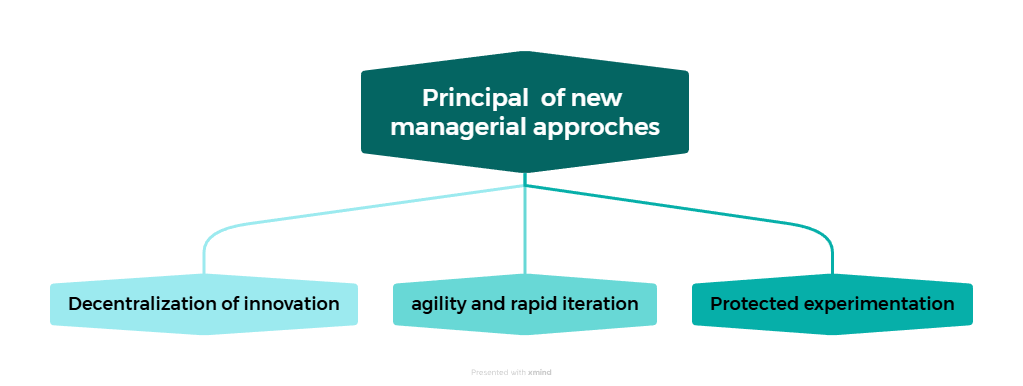
Faced with these limits, new approaches appeared. They share a few simple ideas.
Decentralize innovation: do not keep it in one place but spread it throughout the company. Google did this with its 20% rule. Gmail and AdSense were born from it. The message is clear: innovation can come from anywhere.
Use agility and rapid testing: do not wait for a perfect product but launch small versions and improve quickly. This is the lean startup spirit. Spotify works with small teams (squads) that iterate every two weeks. Risk stays low and teams learn early.
Protect experimentation: create safe spaces where failure is normal, even useful. Amazon promotes fast failure (fail fast). Jeff Bezos repeats it often: if the success rate is too high, the company is not taking enough risks.
Organizational Structures for Innovation
Beyond ideas, what structures do companies create?
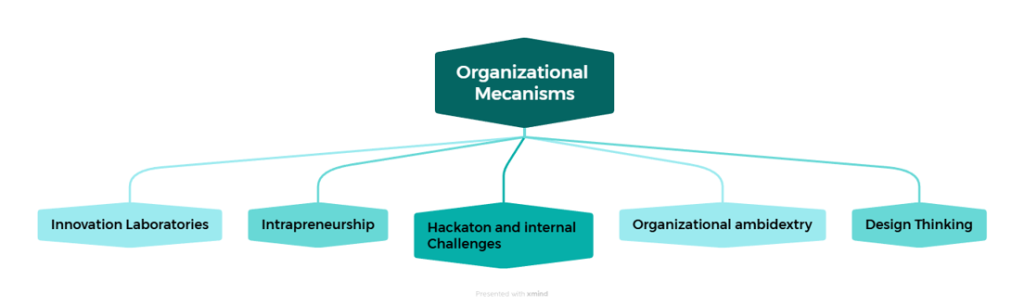
Innovation labs are now common. They act as small free zones where teams can explore new paths without heavy processes. IBM’s Garage is an example, where customers and teams co-create. The goal is simple: break out of routine.
Intrapreneurship goes further. It allows employees to act as founders inside their own company. Gifford Pinchot shaped this idea. Lockheed Martin used it early with its Skunk Works teams—small, free, and isolated. They built revolutionary aircraft.
Hackathons also help. They use collective energy. Facebook organizes them often. Anyone can participate for 24 hours. The Like button was born from one. Thus everyone can contribute to shared innovation.
Ideation platforms extend this logic. They gather ideas at large scale. Ericsson’s IdeaBoxes did this. Thousands of ideas came in. The best were tested and funded. Thus every employee becomes a creator.
Organizational Ambidexterity
A key concept appears: organizational ambidexterity. Companies must exploit what works today while exploring what might work tomorrow. These two paths clash. One needs control, the other needs freedom. Ambidextrous companies separate the two but keep a shared strategy.
Design thinking also helps. It puts the user at the center. The steps are simple: empathy, definition, ideation, then prototypes and tests. IDEO and Stanford spread it widely. SAP trained thousands of people. Thus teams start from real needs, not technology first.
Implementation Challenges
These tools seem great, but using them well is difficult.
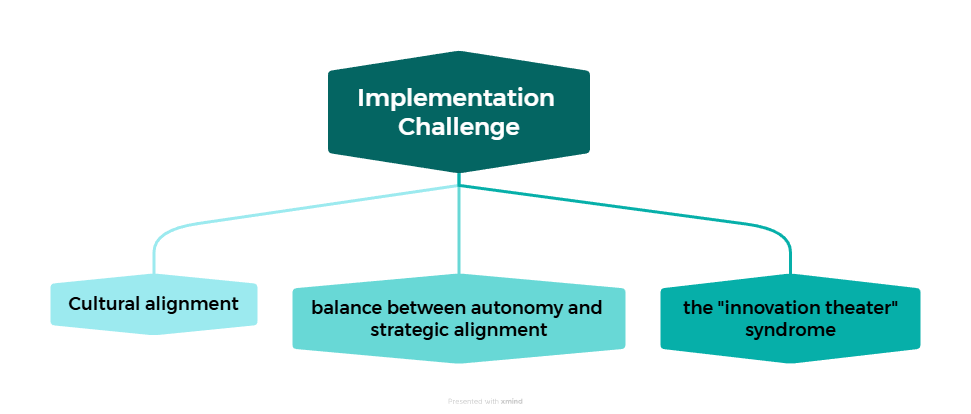
Culture must follow structure: you cannot order creativity. A 15% rule fails if fear and hierarchy block it. Culture takes time. And leaders must support it.
Balance freedom and strategy: teams need autonomy but must stay aligned. Too much control blocks ideas, too little creates chaos. The right balance is subtle.
Avoid innovation theater: some companies organize events, create labs, fill walls with Post-its, but nothing really changes. Innovation remains a spectacle, not a real transformation.