Advanced Innovation & entrepreneurship
-
Introduction
-
MODULE 1: CAPITAL, VALUE, AND ORGANIZATION
Unit 1 Value Creation, the production results2 Topics|1 Quiz -
Unit 2 What is the capital and how is it build ?2 Topics|1 Quiz
-
Unit 3 : Division and organisation of Labor3 Topics|1 Quiz
-
Unit 4 : Capturing and Retaining Created Value2 Topics|1 Quiz
-
Unit 5 : Value chains and their fragmentation, maximizing the value captured2 Topics|1 Quiz
-
MODULE 2: INNOVATION AS A SOCIAL PROCESSUnit 6 : Adoption, a frontier between invention and innovation2 Topics|1 Quiz
-
Unit 7 : Innovation as a social process2 Topics|1 Quiz
-
Unit 8 : Location and Links in innovation3 Topics|1 Quiz
-
Unit 9 : Innovation process between companies2 Topics|1 Quiz
-
Unit 10 : The case of Knowledge industries3 Topics|1 Quiz
-
Unit 11: Values typologie2 Topics|1 Quiz
-
Unit 12 : Innovation as a process of value proposal3 Topics|1 Quiz
-
MODULE 3: DIGITAL TRANSFORMATION, INTANGIBLE CAPITAL AND RESPONSIBILITYUnit 13 : Digital transformation2 Topics|1 Quiz
-
Unit 14 : Intangible capital role in Innovation4 Topics|1 Quiz
-
Unit 15 : Public investment generating positive externalities in service of innovation3 Topics|1 Quiz
-
Unit 16 : Corporate social and environmental responsibility in an innovation context2 Topics|1 Quiz
-
Unit 17 : Innovative management methods of companies2 Topics|1 Quiz
-
Conclusion and ReferencesGeneral Conclusion
-
Bibliographic references
-
Final Assessment1 Quiz
Outsourcing Innovation Management—Open Innovation

Alvaro Pina Stranger 04/11/2026
Use the Listen button to hear the transcript. You can pause and resume the audio, and stop it at any time.
Note: You need to mute the video to hear the transcript in other languages instead of English or it will overlap with the video audio.
Please also keep in mind not all languages are supported by the TTS engine.
The Emergence of the Open Innovation Concept
In the early 2000s, Henry Chesbrough at Berkeley published Open Innovation. This book marked a turning point. It changed how companies think about and manage innovation.
Traditionally, companies used closed innovation. Everything stayed inside, from idea to product. The company controlled all stages. Research was secret. Patents protected results. The boundary stayed firm.
Factors of Change
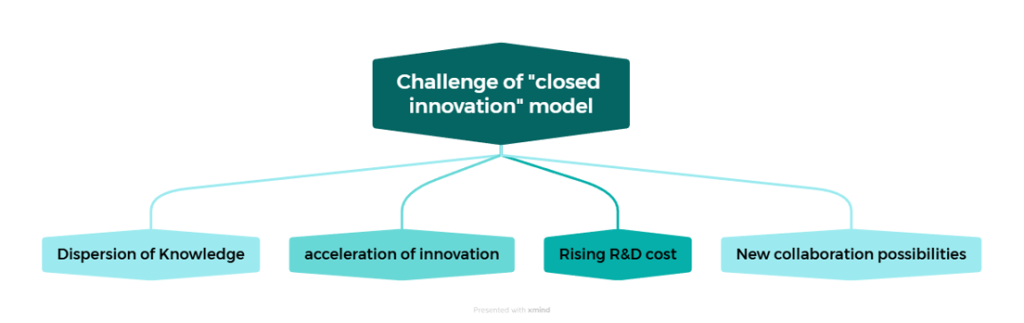
This old model had logic. Knowledge moved slowly. Talent stayed in clusters. So keeping everything inside made economic sense. Big R&D budgets gave power. But things changed fast.
Knowledge spread everywhere: universities train millions. Startups and labs create ideas. No single company can hold all expertise. As Chesbrough said: not all smart people work for you.
Innovation accelerated: technology cycles shortened. Waiting for internal ideas can take too long. So external sources help speed up.
R&D costs exploded: a new drug takes billions. A new aircraft takes decades. Risks are enormous. So sharing them makes sense.
Collaboration became easy: internet tools connect everyone. Thousands can work together at almost no cost. So open innovation became possible.
Forms of Innovation Outsourcing
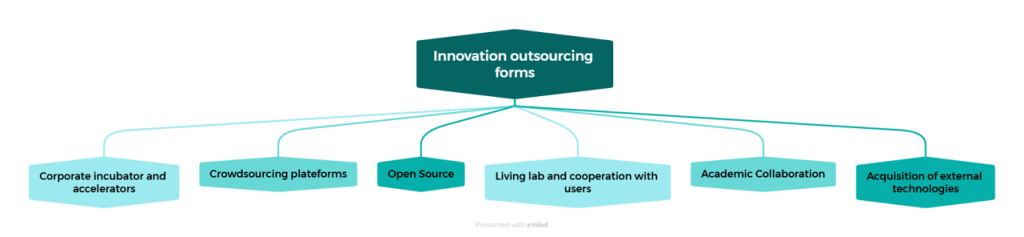
Innovation outsourcing takes several forms.
Strategic partnerships with startups happen everywhere now. Large companies invest or acquire. Google and Amazon do it often. The goal is simple: quickly access new technologies and spot early trends.
Corporate incubators also help. They attract useful startups. LVMH built the Maison des Startups. Airbus launched BizLab. Startups get support and access. The company gets fresh ideas.
Crowdsourcing uses the crowd. InnoCentive posts hard problems. Anyone can propose a solution. If it works, they are rewarded. P&G solved hard problems this way.
Open source reshaped software. Companies now contribute together to shared platforms. Linux, Kubernetes, TensorFlow. Innovation becomes collective and moves much faster.
Living Labs add users early. They help design the product, not just test it later. LEGO Ideas shows this well. Fans propose models. Ten thousand votes trigger review. Thus users become co-creators.
Academic consortia pool research. Competitors join forces before competing in markets. SEMATECH did this in chips. It helped US companies stay strong.
Licenses accelerate access to technology. Companies buy patents instead of reinventing them. Qualcomm built its model on this.
Risks and Challenges
Open innovation brings benefits: it expands the idea pool, cuts R&D costs, speeds up development, and shares risk. But it also brings risks companies must manage.
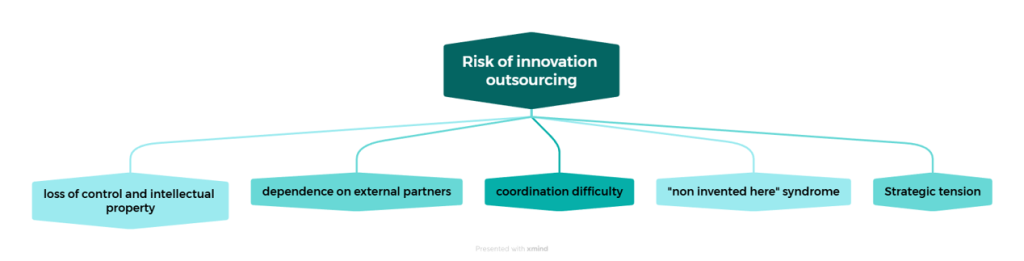
Loss of control: opening up means sharing. How to protect secrets? How to keep an advantage? IP management becomes harder.
Dependence on partners: if companies outsource too much, they lose key skills. If the partner fails or changes direction, the company becomes exposed. So balance is crucial.
Coordination becomes tricky: partners differ in culture, timing, goals. The company must learn to orchestrate an entire ecosystem.
The “not invented here” syndrome: teams may reject external ideas out of pride or fear. This slows progress. So culture must change to value all innovation.
Strategic Implications
A strategic tension remains: how far should a company open up? Too open loses advantage. Too closed loses speed. The right degree varies by sector and strategy.
Outsourcing innovation is not abandoning. It is a deeper engagement with a larger, faster world. No company can innovate alone today. Innovation is now distributed and ecosystem-based.
But this openness requires skills. Companies must choose good partners, set clear rules, integrate external ideas, and protect what matters while sharing enough to grow.
Innovation management changes. It becomes network management. The modern company is not a fortress. It is a connected node in a global web of ideas, ready to capture and develop knowledge born anywhere.
This change raises a question: where does the company begin and where does it end when innovation is shared?